

Germany Prepares Quantum-Secure National ID Cards

- Post-Quantum Cryptography (PQC): Preparatory work completed to equip the next generation of ID cards with chips protected against quantum-computer attacks
- “A decisive step toward the future security of digital identities”
- Technical foundation jointly developed by Bundesdruckerei, Giesecke+Devrient (G+D), the Federal Office for Information Security
- (BSI) and Infineon – a first of its kind worldwide
- Early adoption of hybrid PQC critical, as ID cards remain valid for ten years
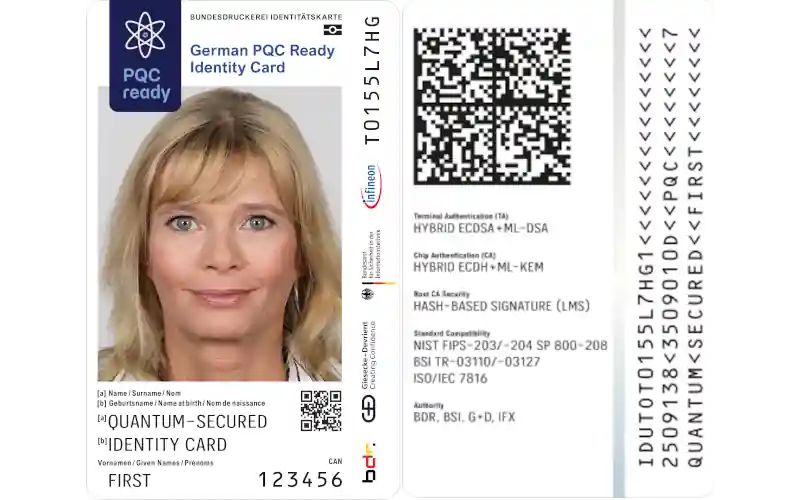
Germany is moving to strengthen its national ID cards against future quantum-computer threats. Since 2010, the country’s ID cards have been recognized as among the most secure worldwide, but officials say new safeguards are needed as each card remains valid for ten years. Bundesdruckerei GmbH and Giesecke+Devrient (G+D), working with the Federal Office for Information Security (BSI), have developed a demonstrator using specialized Infineon chips. The project represents one of the first functional national ID cards combining classical and post-quantum cryptography.
Two-Stage Transition to Quantum Security
The rollout of quantum-secure ID cards will take place in two phases. Initially, personal data will be protected with quantum-resistant digital signatures to prevent forgery. A full transition to post-quantum cryptography will follow, covering both encryption and authentication. This approach aligns with international recommendations for adopting quantum-secure algorithms.
Dr. Kim Nguyen of Bundesdruckerei said the demonstrator proves that quantum-resistant cryptography can be implemented on ID chips. Gabriel von Mitschke-Collande of G+D emphasized that the arrival of “Q-Day,” when quantum computers can break current cryptographic methods, is a matter of time. He noted that industries already explore quantum computing in fields like materials science and pharmaceuticals. Acting now to secure digital infrastructure is seen as essential rather than optional.
Rising Threats from Quantum Computing
Quantum computing has advanced rapidly, though large-scale fault-tolerant systems remain a challenge. Once achieved, such machines could solve mathematical problems like prime factorization far faster than classical computers. This capability threatens established cryptographic systems, particularly key exchange and digital signatures. Sensitive personal data stored in ID cards must therefore be shielded with post-quantum cryptography.
 An EU roadmap calls for PQC adoption in critical applications by 2030. Claudia Plattner, President of the BSI, said governments must be ready to issue quantum-secure ID cards by then. She added that Germany is taking a pioneering role in protecting sovereign documents. The BSI continues to monitor quantum computing progress in regular reports.
Technical Challenges and Future Outlook
Implementing PQC on ID chips requires balancing new security demands with the computational limits of resource-intensive algorithms. G+D has gained experience through government-funded projects such as Aquorypt and Quoryptan. Infineon’s chip design supports fast, side-channel-resistant PQC software implementations, enabling secure integration into ID documents. Bundesdruckerei has also collaborated with Infineon and the Fraunhofer Institute to develop a quantum-secure electronic passport demonstrator in 2022.
The proof of concept for Germany’s next-generation ID cards marks a significant step toward safeguarding digital identities in the quantum era. By combining classical and post-quantum cryptography, the project sets a benchmark for other nations preparing for future threats. Officials believe the transition will ensure that citizens’ personal data remains secure even as computing power evolves. The initiative highlights Germany’s commitment to leading in secure digital infrastructure.
The term “Q-Day” is used by cybersecurity experts to describe the moment when quantum computers become powerful enough to break today’s encryption standards. While the exact timing is uncertain, many governments and companies are already preparing for this scenario, underscoring the urgency of adopting post-quantum cryptography.