

Chilean Telescope Reveals Cosmic Butterfly
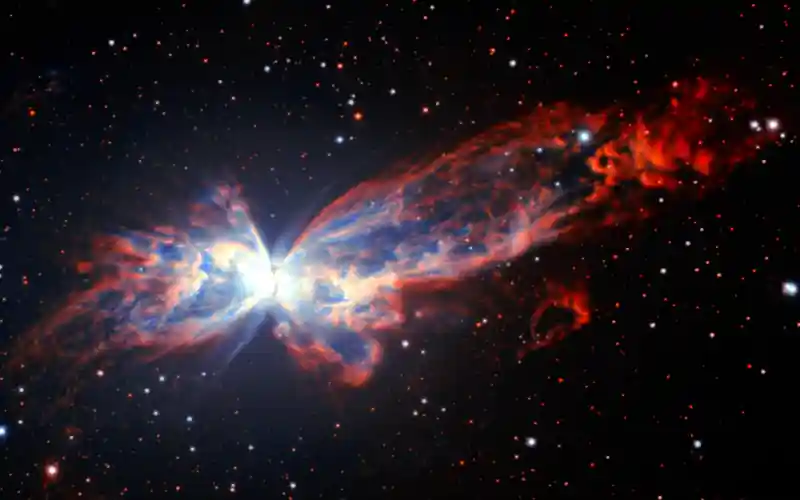
- Capturing a Distant Nebula
A telescope in Chile has produced a striking new image of the Butterfly Nebula, a celestial object located thousands of light-years away. The National Science Foundation’s NoirLab released the picture, which was taken last month by the Gemini South telescope. Situated in the constellation Scorpius, the nebula lies between 2,500 and 3,800 light-years from Earth. For perspective, a single light-year equals about six trillion miles, underscoring the immense distance involved.
Structure and Origins
At the center of this bipolar nebula is a white dwarf star that shed its outer layers of gas long ago. Those discarded gases now form the butterfly-shaped wings that extend outward from the star. Heat from the white dwarf causes the gas to glow, creating the luminous appearance captured in the image. Astronomers note that such structures are common in the late stages of stellar evolution, when stars expel material into surrounding space.
Educational Involvement
The choice of the Butterfly Nebula as an observational target came from schoolchildren in Chile. Their selection was part of a celebration marking 25 years of operation by the International Gemini Observatory. This initiative highlights the role of public engagement in astronomy, connecting scientific milestones with community participation. By involving students, the observatory emphasizes the importance of inspiring future generations of scientists.
The Butterfly Nebula, also known as NGC 6302, has been observed by several major telescopes, including the Hubble Space Telescope, which captured detailed images of its complex structure in 2009. It is considered one of the most extreme planetary nebulae known, with temperatures near its central star estimated to exceed 200,000 degrees Celsius. Such conditions make it a valuable subject for studying how stars evolve and eventually die. The Chilean image adds to a growing archive of observations that help astronomers better understand the life cycles of stars and the beauty of cosmic phenomena.