
Largest Rotating Cosmic Filament Detected
- Study looks at a thread-like filament in the cosmic web
- This filament is populated by almost 300 galaxies
- It is located about 140 million light-years from Earth
Discovery of a Spinning Filament
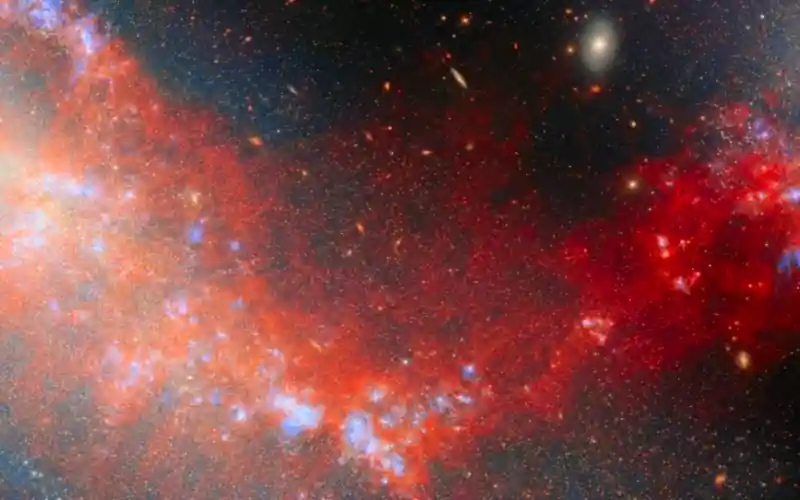
The filament lies about 140 million light-years from Earth and stretches 50 million light-years in length. Nearly 300 galaxies of varying sizes populate the structure, along with gas and dark matter. Observations showed galaxies on opposite sides moving in different directions, confirming rotation at roughly 246,000 miles per hour. By comparison, the Milky Way spans about 100,000 light-years in diameter, making the filament vastly larger.
Madalina Tudorache of the University of Cambridge explained that the universe is organized into a cosmic web of clusters, voids, and filaments. These filaments connect dense regions and border empty spaces. The newly observed filament demonstrates that even these immense structures can rotate. The study was published in the Monthly Notices of the Royal Astronomical Society.
Structure and Motion
Ordinary matter, such as stars and planets, accounts for only 5% of the universe. Dark matter, invisible but detectable through gravitational effects, makes up about 27%. The filament combines both, forming a vast rotating strand within the cosmic web. Each galaxy spins individually, while the entire filament rotates as a whole.
Lyla Jung of the University of Oxford compared the motion to a teacup ride at an amusement park. Galaxies spin like individual cups, while the filament itself turns like the rotating platform. This analogy illustrates the two levels of motion that make the structure unique. Researchers believe other spinning filaments exist but remain undetected with current instruments.
Implications for Cosmic Research
Astrophysicists study the universe at scales ranging from fundamental particles to galaxy clusters. Filaments represent the largest structures in this hierarchy. Detecting rotation in such a filament provides new insight into how matter is distributed and moves across the cosmos. Improved radio and optical surveys are expected to reveal more examples in the future.
Tudorache emphasized that advances in observational technology are expanding the ability to uncover these phenomena. The discovery highlights the dynamic nature of the cosmic web. It also raises questions about how rotation develops in structures spanning tens of millions of light-years. Future studies may clarify whether spinning filaments are common features of the universe.
Cosmic Web Dynamics
|