
Titan’s Ocean Theory Faces New Doubts
- A new study challenges the long‑standing belief that Saturn’s moon Titan hides a global subsurface ocean.
- Researchers now propose that the moon may instead contain deep layers of ice and slush with isolated pockets of liquid water.
- The findings reshape scientific expectations about Titan’s interior and its potential habitability.
Fresh Analysis of Cassini Data
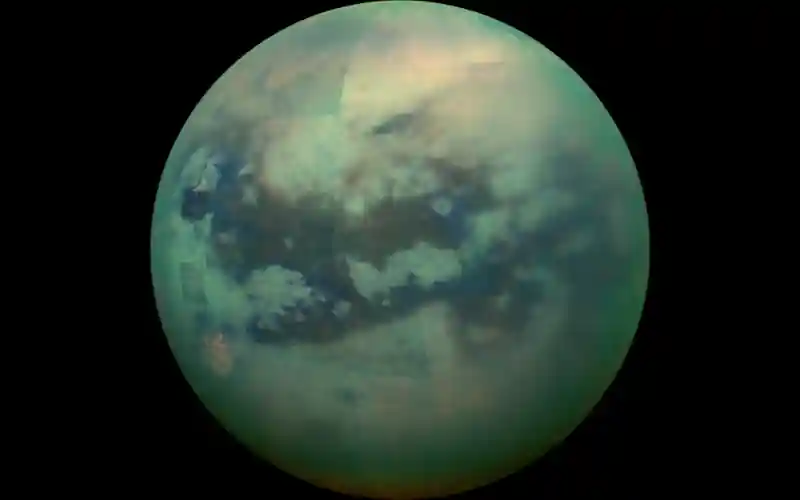
A team led by NASA’s Jet Propulsion Laboratory has re‑examined measurements collected years ago by the Cassini spacecraft. Their results suggest Titan may not host a vast underground ocean, contrary to a decade of scientific assumptions. Instead, the moon could contain thick layers of ice and slush resembling Earth’s polar seas, with occasional pockets of melted water. Scientists emphasize that no signs of life have been detected on Titan, despite its methane lakes and frigid landscape.
The study, published in Nature, highlights the possibility of near‑melting environments beneath Titan’s surface. Such conditions could support microscopic life, according to University of Washington researcher Baptiste Journaux. He noted that nature often produces unexpected biological solutions, leaving room for cautious optimism. The findings add nuance to earlier interpretations of Titan’s internal structure.
Interior Structure and Tidal Clues
Lead author Flavio Petricca said Titan’s ocean may have frozen in the past and could now be partially melting, or the moon’s hydrosphere may be progressing toward full solidification. Computer models indicate that the combined layers of ice, slush and water may extend more than 340 miles deep. The outer ice shell alone could reach 100 miles, covering slushy regions and water pockets that stretch another 250 miles downward. Temperatures in these deeper layers might reach 68 degrees Fahrenheit, creating potentially habitable niches.
Titan’s tidally locked orbit means the same hemisphere always faces Saturn. The planet’s strong gravitational pull deforms Titan’s surface, producing bulges up to 30 feet high during close approaches. Petricca’s team used improved data processing to measure the delay between gravitational peaks and surface response. A 15‑hour lag was detected, which they argue is inconsistent with a global liquid ocean and instead points to a slushy interior.
Scientific Debate and Future Missions
Not all researchers agree with the new interpretation. Luciano Iess of Sapienza University of Rome, whose earlier work supported the buried‑ocean hypothesis, said the evidence remains insufficient to rule Titan out as an ocean world. He expects the findings to spark renewed scientific debate rather than settle the question. Additional data will be needed to determine whether Titan’s interior is dominated by ice or contains significant liquid reservoirs.
NASA’s upcoming Dragonfly mission, scheduled to launch later this decade, is expected to provide crucial insights. The rotorcraft lander will explore Titan’s surface and help clarify the moon’s internal composition. Titan remains one of the most intriguing bodies in the solar system, ranking just behind Jupiter’s Ganymede in size. Other suspected ocean worlds include Saturn’s Enceladus and Jupiter’s Europa, both known for water‑rich plumes erupting from their icy crusts.
Cassini’s long mission around Saturn, from its 2004 arrival to its 2017 plunge into the planet’s atmosphere, transformed scientific understanding of the Saturnian system. Its data continue to fuel new discoveries years after the spacecraft’s end. Titan’s complex chemistry and Earth‑like weather patterns make it a prime target for astrobiology research. The latest study underscores how much remains unknown about the moon’s hidden depths and the environments that may exist far below its frozen surface.