
Hubble Reveals Debris From Rare Space Collisions
- New Hubble observations have revealed the dusty remains of two massive cosmic collisions near the young star Fomalhaut.
- The findings overturn earlier assumptions that a bright spot in the system was a developing planet.
- They also offer a rare opportunity to study violent events that shape planetary systems.
A Mystery Near Fomalhaut Resurfaces
NASA’s Hubble Space Telescope has captured an unusual sequence of events around the nearby star Fomalhaut, offering scientists a clearer view of two large cosmic impacts. Researchers first noticed a bright, compact feature near the star many years ago and initially suspected it might be a planet in formation. Continued monitoring kept the object under scrutiny until new images in 2023 revealed that the bright spot had disappeared entirely. A second luminous feature had emerged in its place, indicating that the original object was not a planet but something far more transient.
The new interpretation points to the aftermath of two separate collisions between large space rocks. These impacts generated dense clouds of dust that briefly mimicked the appearance of planetary bodies. Over time, the debris expanded and thinned out, eventually fading from view as the particles dispersed. Such events are rarely observed directly, making the discovery particularly valuable for astronomers studying early planetary development.
Scientists estimate that the colliding bodies were at least 37 miles, or roughly 60 kilometers, across. Impacts of this scale are thought to occur only once every 100,000 years within the same region, according to prevailing models. The fact that two such events appear to have occurred within two decades has surprised researchers. Joshua Lovell of the Harvard-Smithsonian Center for Astrophysics described the situation as “highly unexpected,” noting that he was not involved in the study.
The findings were published in the journal Science and have prompted renewed interest in the dynamics of young planetary systems. Some scientists believe the observations may simply reflect fortunate timing. Others suspect that collisions may be more common in certain environments than previously assumed. Additional data will be needed to determine whether these events represent an anomaly or a broader pattern.
Why These Collisions Matter
Large-scale impacts between rocky bodies play a central role in shaping planetary systems. They influence the composition of emerging planets and contribute to the distribution of dust and debris around young stars. Studying these collisions provides insight into the processes that governed the early history of our own solar system. Astrophysicist Meredith MacGregor of Johns Hopkins University, who was not part of the research team, compared the observations to “taking a toddler picture of our solar system.”
The dust clouds observed by Hubble offer a snapshot of these formative processes in action. Their evolution over time can reveal how material spreads, cools, and eventually disappears. Researchers plan to continue tracking the newly identified cloud to monitor its changes and eventual dissipation. Each new observation helps refine models of how planetary systems grow and stabilize.
Fomalhaut’s proximity to Earth makes it an especially useful target for long-term study. Located just 25 light-years away, the star sits within what astronomers consider our cosmic neighborhood. A single light-year spans nearly 6 trillion miles, underscoring the vast distances involved even in nearby systems. Despite this scale, Hubble’s instruments can detect subtle changes in the dust clouds surrounding the star.
By observing these events as they unfold, scientists gain a rare opportunity to witness high-energy processes in real time. Study author Paul Kalas of the University of California, Berkeley, emphasized the importance of capturing such moments as they happen. The ability to track these collisions offers a window into the violent interactions that shape young planetary systems. Continued monitoring may reveal additional surprises as the dust continues to evolve.
A Window Into Planetary Formation
The Fomalhaut system has long been a subject of interest due to its prominent debris disk. Earlier observations suggested the presence of planets sculpting the disk’s structure, though some candidates later proved to be dust clouds rather than solid bodies. The new findings reinforce the idea that dynamic collisions can produce features that mimic planetary signatures. This complicates efforts to identify true exoplanets in young systems.
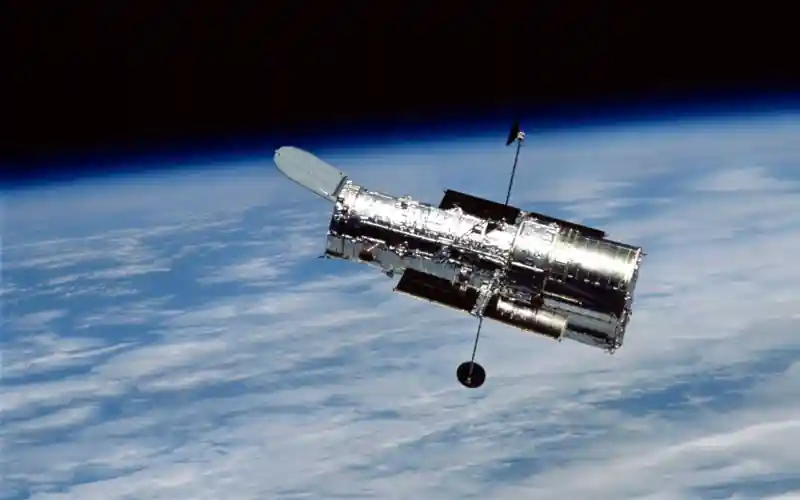
Hubble’s long-term monitoring capabilities make it uniquely suited to detecting such transient phenomena. Its ability to capture high-resolution images over decades allows scientists to track changes that would otherwise go unnoticed. The telescope’s observations have repeatedly challenged assumptions about how debris disks behave. These latest results continue that trend by revealing unexpected levels of activity.
Researchers hope that future instruments will build on Hubble’s work. The James Webb Space Telescope, for example, can observe dust at infrared wavelengths that complement Hubble’s optical data. Combining these perspectives may help scientists better understand the temperature, composition, and distribution of debris. Such insights could clarify how collisions contribute to the architecture of planetary systems.
The study also highlights the importance of long-term astronomical archives. Without decades of accumulated data, the disappearance and reappearance of bright features around Fomalhaut might have been missed. This underscores the value of sustained observation programs that track changes over time. As more data becomes available, astronomers may uncover additional examples of similar events in other systems.
Fomalhaut has been a subject of debate for years because it was once thought to host one of the first directly imaged exoplanets. Later analysis showed that the supposed planet, known as Fomalhaut b, was actually a dust cloud from a previous collision. This history makes the new findings particularly intriguing, as they suggest the system may be far more collision‑prone than expected. The repeated appearance of dust clouds could indicate an unusually active debris environment, offering a valuable natural laboratory for studying planetary formation.