White Dwarf’s Mysterious Shockwave Stuns Astronomers
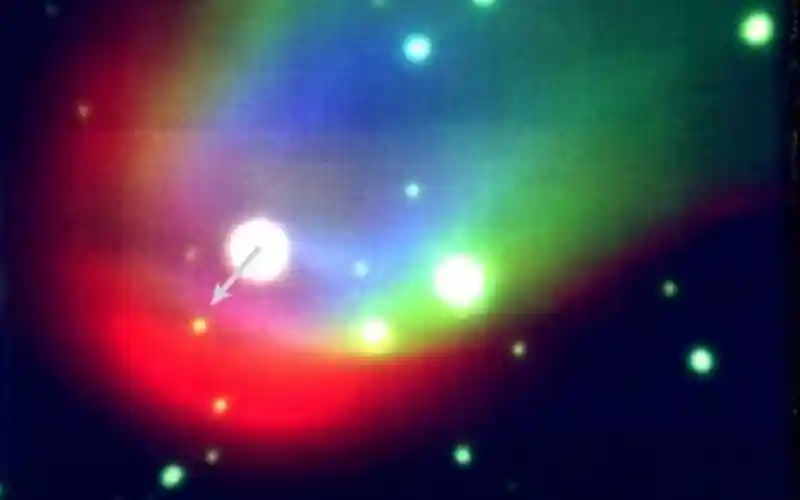
- Astronomers have identified a white dwarf star producing an unusually colorful shockwave as it travels through space.
- The phenomenon, observed with the Very Large Telescope, does not match known models of how such stars behave.
- Researchers are now investigating why this system is ejecting material in a way never seen before.
A Rare Shockwave in a Nearby Binary System
Astronomers have detected a compact white dwarf star generating a vivid bow shock as it moves through interstellar gas. The object sits about 730 light‑years from Earth in the constellation Auriga, forming a tight binary system with a red dwarf companion. Gas is being pulled from the smaller star as the pair orbit each other at close range, completing a full orbit every 80 minutes. The shockwave was captured using the European Southern Observatory’s Very Large Telescope, revealing glowing structures shaped by the collision between outflowing material and surrounding gas.
The colors in the shockwave correspond to different chemical elements heated by the impact. Hydrogen appears red, nitrogen glows green, and oxygen shows up as blue, creating a multicolored arc around the star. These emissions arise when fast‑moving material compresses and heats interstellar gas, forming a curved front similar to the wave produced by a boat cutting through water. Researchers noted that only a few white dwarfs have been seen producing such structures, and all previously known examples were surrounded by gas disks—something this system lacks.
A White Dwarf With Unusual Behavior
White dwarfs represent the final evolutionary stage for most stars with masses up to eight times that of the Sun. After exhausting their hydrogen fuel, such stars shed their outer layers during the red giant phase, leaving behind a dense core roughly the size of Earth. This particular white dwarf has a mass comparable to the Sun but is only slightly larger than our planet. Its companion is a faint red dwarf with about one‑tenth the Sun’s mass and far lower luminosity.
The white dwarf’s strong gravity strips gas from the red dwarf, funneling it along magnetic field lines toward its magnetic poles. This process typically produces energy and radiation but does not explain the large‑scale outflow needed to create the observed shockwave. Scientists remain puzzled by the mechanism driving the material outward into space. The structure’s size and shape indicate that the process has been active for at least a thousand years, suggesting a long‑term phenomenon rather than a brief event.
Implications for Stellar Evolution Research
The discovery highlights how dynamic and complex stellar remnants can be. White dwarfs are among the most common endpoints of stellar evolution, and the Sun is expected to become one billions of years from now. Understanding unusual systems like this may help refine models of how stars lose mass, interact with companions, and shape their surroundings. The team emphasized that the shockwave’s appearance also serves as a reminder that interstellar space is far from empty, containing gas and dust that respond dramatically to stellar activity.
Further investigation will focus on identifying the unknown mechanism responsible for the outflow. Additional observations may reveal whether magnetic processes, episodic eruptions, or previously unrecognized interactions are at play. The researchers hope that studying this system will shed light on how white dwarfs behave under extreme conditions. Its long‑lived shockwave offers a rare opportunity to examine how stellar remnants influence their environment over extended periods.
White dwarfs with strong magnetic fields—known as magnetic white dwarfs—are relatively uncommon, making this system particularly noteworthy. Interestingly, the bow shock resembles structures seen around runaway massive stars, even though white dwarfs typically lack the powerful winds needed to create such features. This unusual combination of properties may point to a new category of stellar behavior that has yet to be fully explored.