
Tracking the Sun’s Most Intense Region in Decades
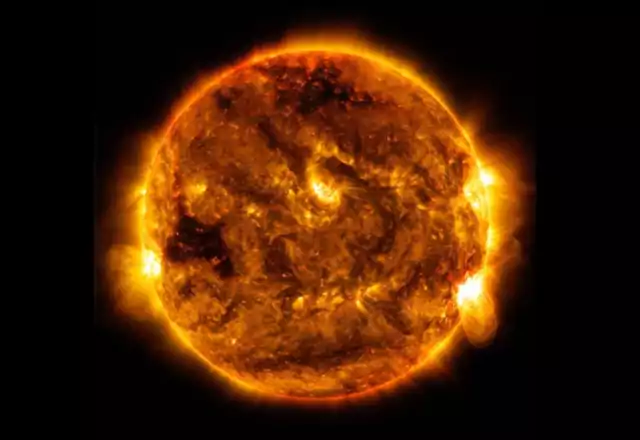
- A pair of spacecraft has captured an unusually active solar region as it evolved into a powerful superstorm.
- Their combined observations provided an unprecedented 94‑day view of the region’s development across multiple solar rotations.
- The findings could improve future space‑weather forecasting and highlight the Sun’s growing impact on modern technology.
A New Window Into the Sun
The Sun rotates roughly every 28 days, which limits how long Earth‑based observers can monitor any active region. Once a region moves out of view, it remains hidden for about two weeks before returning to the visible side. This natural limitation makes it difficult to follow the full life cycle of highly active areas. ESA’s Solar Orbiter mission, launched in 2020, has changed this by providing access to regions normally concealed from Earth.
Solar Orbiter travels on a wide, six‑month orbit around the Sun, giving it a vantage point unavailable to ground‑based telescopes. Its trajectory allows it to observe the Sun’s far side, where active regions often develop unnoticed. Ioannis Kontogiannis of ETH Zurich and IRSOL notes that this expanded perspective has become essential for understanding solar behavior. The spacecraft’s unique orbit has enabled scientists to track solar activity with far greater continuity.
A Rare Look at NOAA 13664
Between April and July 2024, Solar Orbiter recorded one of the most active solar regions seen in twenty years. The region, designated NOAA 13664, rotated into Earth’s view in May 2024 and immediately produced intense activity. It triggered the strongest geomagnetic storms since 2003, generating auroras visible unusually far south. Louise Harra of ETH Zurich explains that the region was responsible for the striking northern lights seen even in Switzerland.
Researchers formed an international team to study the region’s evolution in detail. They combined Solar Orbiter’s far‑side observations with continuous data from NASA’s Solar Dynamics Observatory. This pairing allowed them to monitor NOAA 13664 almost without interruption for 94 days. The result was the most complete observational record ever assembled for a single solar region.
Building a Continuous Solar Record
Kontogiannis describes the dataset as the longest continuous image sequence ever created for one active region. The team followed NOAA 13664 from its emergence on 16 April 2024 until its decay after 18 July 2024. This extended timeline revealed subtle changes that would normally be missed due to the Sun’s rotation. The ability to track the region across multiple rotations marked a milestone in solar research.
Active regions are shaped by powerful magnetic fields rising from the Sun’s interior. These fields can twist and tangle as they emerge, storing large amounts of energy. When the magnetic structure becomes unstable, it can release energy through solar flares or massive plasma ejections. Such events can send high‑energy particles across the solar system and toward Earth.
Understanding the Forces Behind Solar Storms
Magnetic Fields and Solar Eruptions
Solar flares occur when magnetic fields snap and reorganize, releasing bursts of electromagnetic radiation. These eruptions can also launch clouds of charged particles known as coronal mass ejections. When directed toward Earth, these events can disturb the planet’s magnetic field and atmosphere. The resulting geomagnetic storms can vary widely in intensity.
While auroras are the most visible effect of solar storms, the consequences extend much further. Strong disturbances can disrupt power grids and interfere with radio communications. Aircraft flying at high altitudes may experience increased radiation exposure during major events. Satellites are particularly vulnerable to atmospheric drag and charged‑particle damage.
Technology at Risk
A notable example occurred in February 2022, when heightened solar activity caused 38 newly launched Starlink satellites to fail. The satellites encountered increased atmospheric density, which prevented them from reaching stable orbit. Similar disruptions can affect navigation systems, communication networks, and Earth‑observation satellites. These vulnerabilities highlight the importance of accurate space‑weather forecasting.
Harra notes that even terrestrial systems can be affected by geomagnetic disturbances. Railway signals may switch unexpectedly between red and green, creating safety concerns. During the May 2024 storms, modern agricultural systems experienced significant disruptions. Farmers relying on satellite‑guided equipment lost working days, and some reported crop losses due to malfunctioning sensors and drones.
Why Continuous Monitoring Matters
Kontogiannis emphasizes that the Sun is the only star with a direct influence on human activity. Understanding its behavior is essential for protecting modern infrastructure. Continuous monitoring helps scientists identify patterns in magnetic field evolution. Such insights could eventually lead to more reliable predictions of solar storms.
Toward Better Space‑Weather Forecasts
Following a Region Through Three Rotations
For the first time, researchers tracked a superactive region through three full solar rotations. This long‑term view revealed how NOAA 13664’s magnetic structure grew increasingly complex. The fields eventually formed a tightly wound configuration capable of releasing enormous energy. On 20 May 2024, the region produced the most powerful solar flare in two decades, though it occurred on the Sun’s far side.
Scientists hope that studying such long‑lived regions will improve forecasting models. Complex magnetic fields often indicate that a region contains large amounts of stored energy. However, predicting whether that energy will be released in one major eruption or several smaller ones remains difficult. The timing of these events is also challenging to determine with current tools.
Future Missions and New Capabilities
Harra explains that researchers are still far from predicting solar storms with precision. ESA is developing a new mission called Vigil, dedicated entirely to monitoring space weather. Scheduled for launch in 2031, the spacecraft will provide continuous observations from a strategic position away from Earth. Its data could help scientists detect early signs of dangerous solar activity.
Improved forecasting would benefit satellites, power systems, and communication networks. It could also help industries such as aviation and agriculture prepare for disruptions. As solar activity increases during the current solar cycle, the need for reliable predictions becomes more urgent. Missions like Solar Orbiter and Vigil represent important steps toward that goal.
Solar Cycle 25, which began in 2019, has been significantly more active than early forecasts predicted. Several major flares and geomagnetic storms have already exceeded expectations, suggesting the cycle may peak at higher intensity than originally estimated. This trend has renewed scientific interest in long‑term solar monitoring and highlighted the importance of international cooperation in space‑weather research.