
Ubisoft Shares Plunge After Major Restructuring

- Ubisoft plans sweeping reorganisation.
- Company cancels six games, delays seven more.
- Shares fall to their lowest price in 14 years.
Restructuring Follows Years of Weak Results
Ubisoft revealed a sweeping reorganisation aimed at reducing costs and improving creative focus after a prolonged period of disappointing releases. The company plans to divide its operations into five genre‑based creative divisions, marking a significant shift in internal structure. Shares fell by as much as 35% following the announcement, putting the stock on track for its largest single‑day decline since its 1996 market debut. The publisher confirmed it would cancel six games, including a planned remake of Prince of Persia, while delaying seven additional titles.
The restructuring includes the closure of Ubisoft studios in Halifax and Stockholm, with further changes expected in other regions. Management also lowered its net bookings forecast for 2026 and withdrew guidance for the 2026/27 fiscal year, signalling uncertainty about future performance. These decisions follow several years marked by delays, cancellations and inconsistent execution, which have weakened investor confidence. The company’s financial challenges intensified in late 2025 when a last‑minute delay of half‑year results led to a week‑long suspension of trading.
Debt Concerns Add to Market Reaction
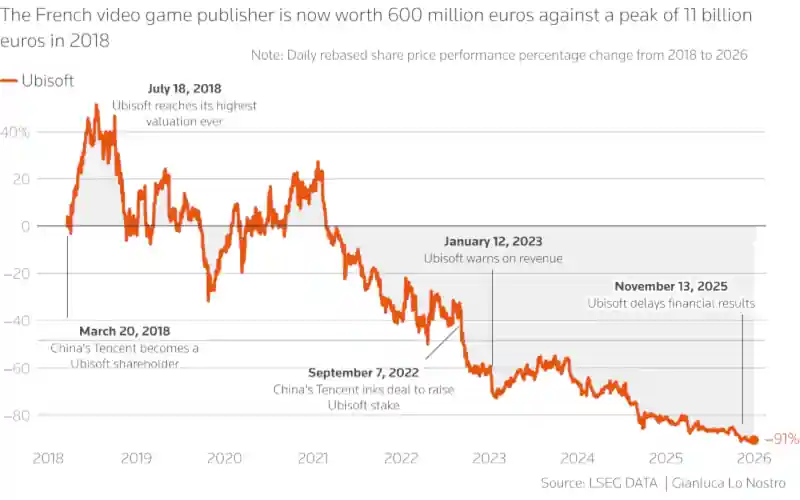
Ubisoft later disclosed that an accounting adjustment had revealed a breach of debt covenants, prompting the use of part of Tencent’s €1‑billion investment to repay loans early. Analysts warned that the company’s ability to generate positive cash flow remains uncertain in the near term. Corentin Marty of TP ICAP Midcap described the restructuring as a “big shake‑up” but cautioned that the maturity of a €675‑million bond in 2027 could further strain the firm’s finances. Early Thursday trading valued Ubisoft at around €616 million, reflecting a steep decline from previous years.
The company’s stock has lost nearly half its value over the past year and now sits well below €1 billion in market capitalisation. This marks a dramatic fall from its 2018 peak of approximately €11 billion, according to LSEG data. Investors appear increasingly concerned about the publisher’s ability to stabilise operations and deliver consistent releases. The restructuring aims to address these issues, though its long‑term impact remains uncertain.
Ubisoft’s shift to genre‑based creative divisions mirrors a trend seen at other major publishers seeking to streamline development pipelines. Industry analysts note that large‑scale game production has become more expensive and complex, increasing the risks associated with delays and cancellations. The company’s challenges highlight broader pressures across the gaming sector, where rising budgets and longer development cycles have made financial performance more volatile.