
Oldest Known Rock Art Found in Indonesian Cave
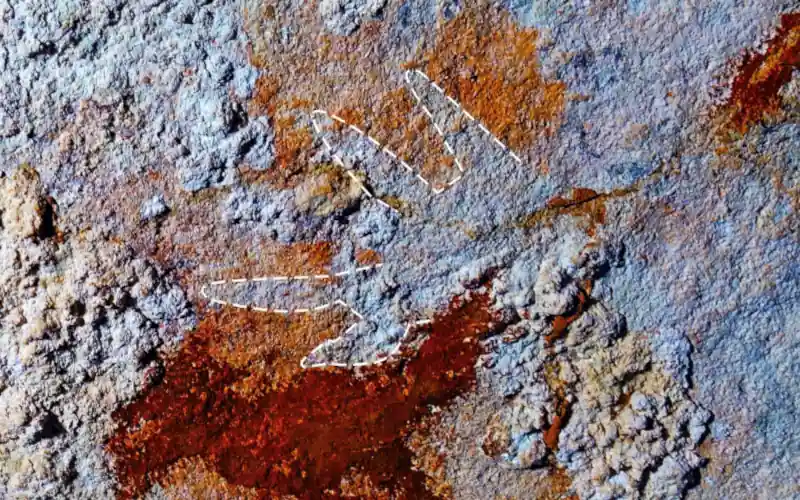
- Painted outline of a hand found in cave on Muna island.
- The image on a cave wall is faded and barely visible.
- The hand stencil dates to at least 67,800 years ago.
Discovery and dating
Researchers working at Liang Metanduno cave on Muna Island identified a faint reddish hand stencil that they date to at least 67,800 years ago. The image survives only as a faded outline on the limestone wall, yet it represents a clear instance of early symbolic behaviour. They established the minimum age by measuring uranium in mineral deposits that formed on top of the pigment, a method that provides a reliable lower bound. Dating results place the stencil well before several other notable regional artworks, expanding the timeline for early human expression in the area.
The stencil was produced by blowing pigment over a hand pressed against the rock, a technique known from other prehistoric sites worldwide. To confirm that the motif was not a one-off, researchers located nearly identical images in better condition elsewhere around the cave complex. Similar designs suggest a local artistic convention rather than an isolated experiment. The technique and repetition together indicate that symbolic marking was an established practice among these ancient communities.
Style and cultural meaning
Maxime Aubert of Griffith University, who led the study, noted that the stencil’s fingertips were deliberately reshaped to appear pointed, a stylistic trait found only in Sulawesi. Co‑author Adam Brumm suggested that the modification might have been intended to evoke animal claws or other non‑human attributes, implying a symbolic relationship with the natural world. Although the precise meaning remains unknown, the deliberate alteration points to abstract thinking and cultural intent. Nearby caves also contain human figures with animal features dated to later periods, reinforcing the idea of a sustained symbolic tradition.
The newly dated stencil predates a 51,200‑year‑old scene at Leang Karampuang and a roughly 64,000‑year‑old hand stencil in Spain that has been attributed to Neanderthals. It therefore represents the oldest direct evidence of modern human rock art discovered to date. Earlier Sulawesi research has documented hybrid human‑animal imagery going back at least 48,000 years, showing continuity in regional motifs. These patterns suggest that diverse artistic expressions were part of the cultural repertoire of early populations in the archipelago.
Implications for migration and chronology
Researchers argue that the people who made the Liang Metanduno stencil were part of a broader population moving from mainland Asia through the Indonesian islands and eventually toward Australia. For decades, debate has centred on whether Australia was first settled around 50,000 years ago (the “short chronology”) or significantly earlier (the “long chronology”). The new rock‑art date supports the long chronology by providing archaeological evidence of modern human presence in the region closer to 60,000–65,000 years ago. Genetic studies of Aboriginal Australian and Papuan populations have recently lent independent support to an earlier arrival, aligning with the archaeological record.
Scientists hope the finding will prompt renewed surveys of caves across Sulawesi and neighbouring islands to refine migration models. Their work underscores how symbolic behaviour can serve as a marker of population movement and cultural continuity. Liang Metanduno, already known for later Austronesian‑era paintings, now offers a much deeper time depth for human activity at the site. Continued excavation and dating could reveal whether the pointed‑finger motif appears elsewhere and how artistic traditions spread across maritime Southeast Asia.
The hand‑stencil technique—spraying pigment around a hand—appears in prehistoric sites on multiple continents, but regional variations such as Sulawesi’s pointed fingertips are rare. Sulawesi has yielded several high‑profile early art discoveries in recent years, making it a focal point for studies of early symbolic culture outside Africa and Europe. The island’s limestone caves preserve pigments and mineral layers well, enabling uranium‑series dating that can reach beyond the limits of radiocarbon methods. Future work combining archaeological finds with genetic and environmental data may further clarify the routes and timing of early human dispersals through Southeast Asia.