

Black Hole’s Unusual Outburst Continues for Years
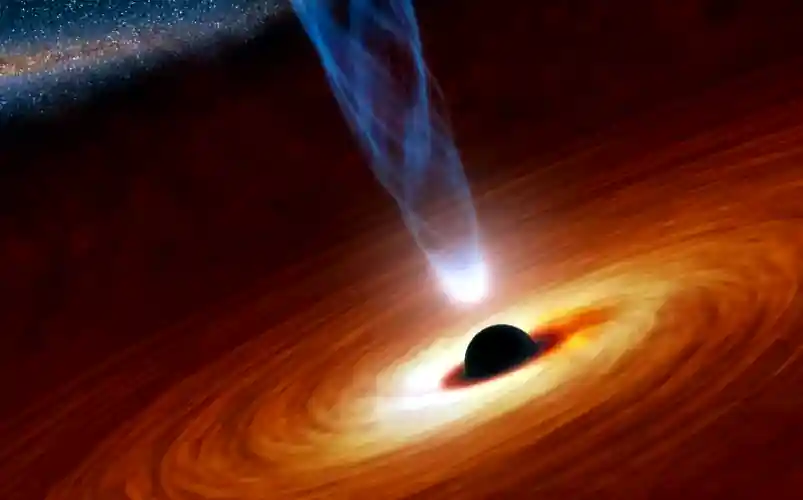
- Astronomers are tracking a supermassive black hole that has been emitting an unusually long‑lasting jet of material after destroying a nearby star.
- The event has intensified for six years, far longer than similar phenomena observed in the past.
- Researchers say the behavior is unprecedented and may offer new insight into how black holes interact with their surroundings.
A Black Hole With Unusually Persistent Activity
Scientists are observing a distant supermassive black hole that continues to release a powerful jet years after tearing apart a star. The object sits roughly 665 million light‑years from Earth, far outside the Milky Way. Its behavior is being monitored primarily through radio telescopes in New Mexico and South Africa. Researchers say the duration and intensity of the jet make this one of the most remarkable events of its kind.
The black hole consumed a red dwarf star about one‑tenth the mass of the Sun. Material from the star was pulled apart by extreme gravitational forces in what is known as a tidal disruption event. Surprisingly, the jet did not appear until two years after the star was destroyed. It has since continued for six years and shows no sign of slowing down.
Lead researcher Yvette Cendes of the University of Oregon described the jet’s rapid brightening as unprecedented. The radio emission is now about 50 times stronger than when it was first detected. Such a long‑lasting and intensifying outflow has not been seen before. The findings were published in the Astrophysical Journal.
What Happens When a Star Gets Too Close
Black holes are extremely dense objects whose gravity is so strong that not even light can escape. When a star approaches too closely, it crosses a threshold called the event horizon. Before reaching that point, tidal forces can stretch the star into a long stream of debris, a process sometimes referred to as “spaghettification.” The black hole then consumes part of this material while ejecting the rest.
Co‑author Kate Alexander of the University of Arizona explained that the bright radio emission comes from gas that approached the event horizon but never crossed it. This leftover material is accelerated outward at high speed, producing the jet observed by astronomers. The researchers compare the process to a child spitting out food rather than swallowing it. Such behavior helps scientists understand how black holes feed and how they expel energy into their host galaxies.
The black hole involved in this event is about five million times more massive than the Sun. That makes it similar in scale to the supermassive black hole at the center of the Milky Way. Events like this provide rare opportunities to study how black holes interact with stars and how they influence their environments. The long duration of the jet makes this case particularly valuable.
A Jet With No Clear Explanation
Despite years of observation, scientists still do not know why this jet has lasted so long. Relativistic jets are thought to be linked to magnetic fields around black holes, but the exact mechanism remains unclear. Cendes noted that if such events were common, astronomers would see them more frequently. The unusual nature of this case suggests that specific conditions may have triggered the extended outflow.
Researchers believe the jet may reach its peak brightness later this year or next year. After that, it is expected to fade slowly over a decade or more. Continued monitoring will help scientists understand how the jet evolves and what it reveals about the black hole’s surroundings. The event may also shed light on how black holes influence galaxy formation.
The team plans to keep observing the system using radio telescopes capable of tracking faint and distant signals. Long‑term data will be essential for building models of how such jets form and why they vary so dramatically. The event’s exceptional brightness makes it easier to study than most tidal disruption events. Its longevity ensures that astronomers will have years of additional data to analyze.
Tidal disruption events are rare, with only a few detected each year across the observable universe. Most produce short‑lived emissions that fade within months. This makes the current event one of the most persistent ever recorded. Its unusual behavior may help refine theories about how black holes generate jets and how magnetic fields shape these extreme cosmic outflows.