SIA: Chip Sales Surge to Record Levels in 2025

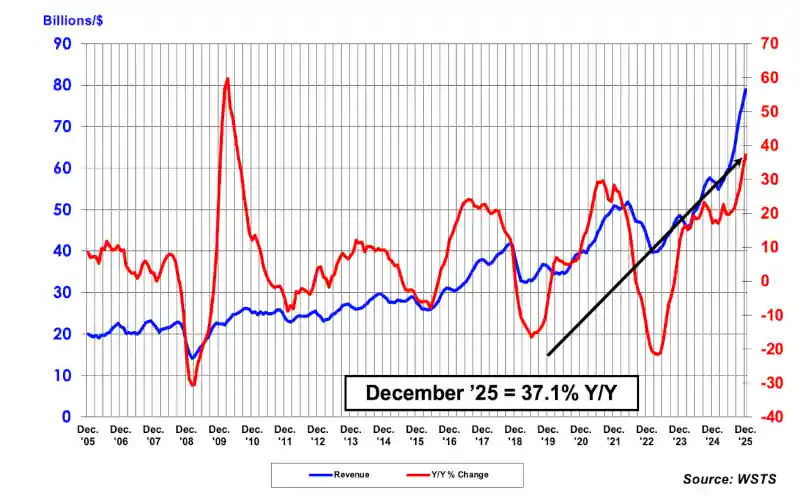
- Global semiconductor sales reached $791.7 billion in 2025, marking a 25.6% increase over the previous year.
- Logic and memory products drove much of the growth, and industry forecasts suggest worldwide sales could approach $1 trillion in 2026.
- Regional markets expanded unevenly, but overall demand remained strong across emerging technologies.
Semiconductor Market Reaches New Heights
The Semiconductor Industry Association (SIA) reported that global chip sales rose to $791.7 billion in 2025, up from $630.5 billion in 2024. Fourth‑quarter sales reached $236.6 billion, representing a 37.1% increase compared to the same period a year earlier. Month‑to‑month figures also showed steady momentum, with December sales rising 2.7% from November. These numbers are based on World Semiconductor Trade Statistics (WSTS) data, which uses a three‑month moving average to track market trends.
SIA president and CEO John Neuffer said the industry achieved its highest annual revenue to date. He noted that semiconductors underpin nearly all modern technologies, from AI and IoT to autonomous vehicles and next‑generation connectivity. Continued growth in these sectors is expected to sustain strong chip demand. Projections indicate that global semiconductor sales could reach roughly $1 trillion in 2026.
The SIA represents nearly all U.S. semiconductor companies by revenue and a significant portion of international firms. Its reports are widely used to gauge the health of the global chip market. The 2025 results reflect both cyclical recovery and long‑term structural demand. Analysts say the industry is entering a period of sustained expansion.
Regional Growth Shows Mixed Performance
Regional sales data revealed uneven growth across global markets. Asia Pacific and “All Others” saw the strongest annual increase at 45%, followed by the Americas at 30.5%. China posted a 17.3% rise, while Europe recorded a more modest 6.3% gain. Japan was the only region to decline, with sales falling 4.7% year‑on‑year.
Month‑to‑month figures for December showed similar patterns. The Americas grew 3.9%, China 3.8% and Asia Pacific 2.5%. Europe and Japan experienced slight declines of 2.2% and 2.5%, respectively. These variations reflect differences in local demand, supply chain conditions and investment cycles. Despite regional disparities, global totals remained firmly positive.
Neuffer emphasized the importance of strengthening the U.S. semiconductor ecosystem. He argued that competitive domestic policies are essential for economic growth and national security. The U.S. government has been investing heavily in chip manufacturing and research through recent legislation. Industry leaders say these efforts will help maintain global leadership in advanced technologies.
Logic and Memory Products Drive Market Expansion
Several product segments stood out in 2025. Logic chips generated $301.9 billion in revenue, a 39.9% increase that made them the largest category by sales. Memory products followed with $223.1 billion, rising 34.8% from the previous year. These two segments together accounted for a substantial portion of the industry’s overall growth. Their performance reflects rising demand for high‑performance computing, data centers and AI‑driven applications.
Other categories also contributed to the market’s expansion, though at smaller scales. The continued rollout of 5G and early development of 6G technologies supported demand for specialized components. Automotive electronics remained a strong growth area as electric and autonomous vehicles advanced. Consumer devices, while more cyclical, benefited from renewed interest in premium hardware.
SIA encourages industry stakeholders to consult WSTS subscription data for more detailed monthly forecasts. Historical trends and long‑term projections are also available through the SIA Databook. These resources help companies plan manufacturing capacity, investment strategies and supply chain operations. The association expects continued volatility but strong overall growth in the years ahead.
The semiconductor industry’s path toward $1 trillion in annual sales has been a topic of discussion for more than a decade. Analysts note that AI acceleration, cloud infrastructure and edge computing are now pushing demand faster than earlier forecasts predicted. If current trends continue, semiconductors may become one of the largest global technology markets by revenue, rivaling entire sectors such as energy or automotive.