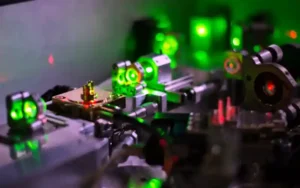

Paper‑Thin Chip Steers Light in New Directions
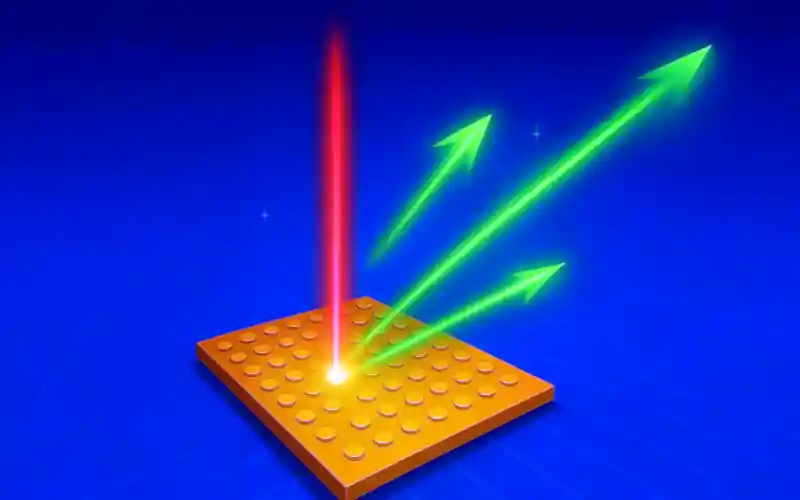
- Researchers at the CUNY Advanced Science Research Center have developed an ultra‑thin metasurface chip capable of converting infrared light into visible light and steering it without any moving parts.
- The device overcomes a long‑standing tradeoff between efficiency and control in light‑shaping technologies.
- Its design could enable compact, chip‑integrated light sources for applications ranging from LiDAR to quantum optics.
A New Approach to Controlling Light on a Chip
Scientists at the CUNY Graduate Center’s Advanced Science Research Center have created a paper‑thin chip that can change the color of incoming infrared light and direct it as a narrow, steerable beam. The device relies on a metasurface—an array of nanoscale structures smaller than the wavelength of light—to manipulate light without mechanical components. When struck by an infrared laser, the chip shifts the light to a higher frequency and emits it as a focused visible beam. The direction of that beam can be adjusted simply by altering the polarization of the incoming light.
In laboratory tests, the team converted infrared light at around 1530 nanometers—similar to wavelengths used in fiber‑optic communications—into green light near 510 nanometers. They also demonstrated precise control over the angle of the outgoing beam. This combination of color conversion and beam steering on a flat chip represents a significant advance in photonic engineering. Andrea Alù, founding director of the CUNY ASRC Photonics Initiative, described the device as a microscopic spotlight capable of both shifting and directing light.
The chip’s design allows different regions of the surface to work together to enhance efficiency. This collective behavior helps overcome limitations seen in earlier metasurface technologies. The result is a compact platform that can manipulate light in ways previously achievable only with larger, more complex systems. Researchers say the approach could be adapted to a wide range of materials and wavelengths.
Solving a Long‑Standing Engineering Tradeoff
Metasurfaces have long been used to bend, focus and shape light, but engineers have struggled to balance efficiency with fine‑grained control. Designs that adjust light at each point on the surface often sacrifice signal strength. Conversely, designs that boost efficiency by allowing light waves to interact across the entire surface typically lose the ability to shape beams precisely. The new device is the first to overcome this tradeoff for nonlinear light generation.
The chip uses a collective resonance known as a quasi bound state in the continuum to trap and intensify incoming infrared light. This resonance boosts the efficiency of the nonlinear process that converts one color of light into another. At the same time, each nanoscale element on the surface is rotated in a carefully engineered pattern. This arrangement gives the outgoing light a position‑dependent phase, similar to how a lens or prism shapes a beam.
Thanks to this combination of collective resonance and local control, the metasurface generates third‑harmonic light—light with three times the frequency of the incoming beam—while steering it in specific directions. Changing the polarization of the incoming light reverses the steering direction. This provides a simple way to control the beam without moving parts or external optics.
The researchers report that the device is roughly 100 times more efficient than comparable beam‑shaping systems that lack collective resonances. This level of performance makes it a promising candidate for integration into compact optical systems. The approach could also be extended to other nonlinear processes and wavelengths.
Toward Ultra‑Compact Photonic Technologies
The ability to generate and steer new colors of light on a flat chip opens the door to a range of applications. Lead author Michele Cotrufo, now at the University of Rochester, said the platform could support ultra‑compact light sources and beam‑steering components for technologies such as LiDAR, quantum light generation and optical signal processing. Because the concept is based on geometry rather than a specific material, it can be adapted to different nonlinear materials and wavelengths, including ultraviolet light.
Future versions of the technology may involve stacking multiple metasurfaces, each optimized for a different wavelength range. This could enable devices that operate efficiently across broad portions of the spectrum. The researchers note that integrating such metasurfaces directly onto chips could significantly reduce the size and complexity of optical systems.
The work was supported by the U.S. Department of Defense, the Simons Foundation and the European Research Council. These organizations have shown increasing interest in compact photonic technologies that can be deployed in communication, sensing and computing systems. The new metasurface design represents a step toward integrating advanced light‑shaping capabilities into everyday devices.
Metasurfaces have become a major focus in modern photonics because they can replace bulky optical components with flat, nanoscale structures. Recent advances have enabled applications in holography, augmented reality and compact imaging systems. The CUNY team’s achievement adds nonlinear light conversion and beam steering to this growing toolkit, potentially accelerating the development of chip‑scale optical technologies.