
Twin Beams Break Through a Hidden Star
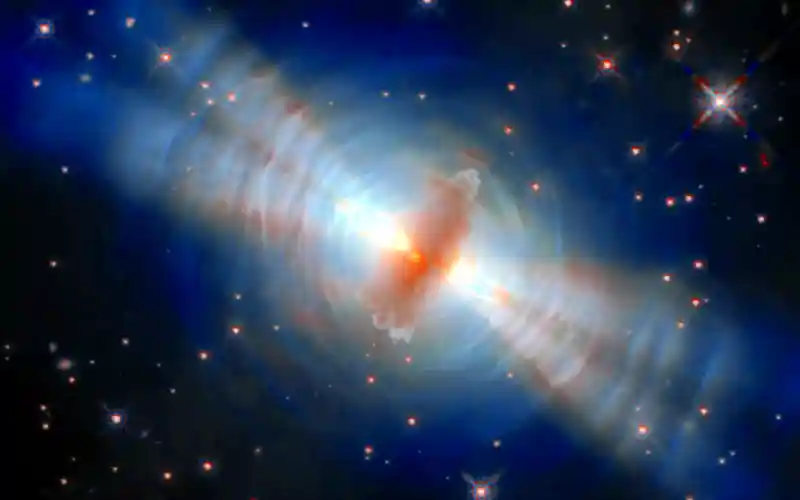
- A new Hubble Space Telescope image offers the clearest look yet at the Egg Nebula, a rare and short‑lived stage in the death of a Sun‑like star.
- The observations reveal twin beams of light piercing a dense shell of dust, shaping the nebula’s distinctive arcs and lobes.
- Scientists say the structure provides a valuable glimpse into how stars shed their outer layers before becoming planetary nebulae.
A Rare Window Into a Dying Star
A recently released Hubble image reveals striking details inside the Egg Nebula, a pre‑planetary nebula located about 1,000 light‑years away in Cygnus. The object surrounds a dying star that remains hidden within a thick cocoon of dust, allowing only narrow beams of light to escape through a polar opening. These beams illuminate expanding lobes and faint ripples that trace the star’s recent outbursts. Researchers believe the symmetrical patterns may indicate the presence of one or more unseen companion stars influencing the nebula’s shape.
The Egg Nebula is notable for being the first, youngest and closest pre‑planetary nebula ever identified. This phase occurs after a Sun‑like star expels its outer layers but before the exposed core becomes hot enough to ionize the surrounding gas. During this brief period, the nebula shines mainly by reflecting starlight rather than emitting its own glow. Because the stage lasts only a few thousand years, astronomers rarely catch such objects in transition.
Hubble’s high‑resolution imaging allows scientists to study the fine structures within the nebula. The newest observations were taken with the Wide Field Camera 3, which captures both visible and infrared light. These wavelengths help reveal dust patterns that would otherwise remain hidden. The result is a detailed portrait of a star in the midst of dramatic change.
How the Nebula Is Taking Shape
The central star’s light escapes through a narrow opening in the dust, creating two bright beams that illuminate fast‑moving polar lobes. These lobes push through older, slower shells of material arranged in concentric arcs around the star. The arcs likely formed from episodic bursts of mass loss, each leaving behind a distinct ring. Their symmetry suggests a coordinated process rather than a chaotic explosion.
Astronomers suspect that gravitational interactions with companion stars may help shape the nebula. These companions remain concealed within the dense dust disk, but their influence can be inferred from the nebula’s structure and motion. The dusty disk itself was expelled only a few hundred years ago, making it a relatively fresh feature. Studying such recent activity helps researchers understand how stars shed material near the end of their lives.
As the star continues to evolve, its core will eventually heat up enough to ionize the surrounding gas. At that point, the Egg Nebula will transition into a full planetary nebula, similar to well‑known examples like the Helix or Butterfly Nebula. For now, it remains in a reflective, dust‑dominated state that offers a unique view of the early stages of this transformation.
Hubble’s Long‑Term View
The Egg Nebula has been a recurring target for Hubble since the telescope’s early years. A visible‑light image from the WFPC2 camera provided the first detailed look at its structure. Later observations with NICMOS in 1997 revealed the nebula’s infrared glow, while the ACS instrument in 2003 captured its extended dusty ripples. The 2012 WFC3 data focused on the dense central region and the powerful outflows emerging from it.
The latest image combines these earlier datasets with new observations to create the most complete view to date. This long‑term record helps astronomers track subtle changes in the nebula’s shape and brightness over time. Such comparisons are valuable because the pre‑planetary phase evolves quickly on astronomical timescales. Continued monitoring may reveal how the star’s outflows interact with older material as the nebula expands.
Hubble’s decades‑long mission continues to provide insights into stellar evolution. The telescope is operated jointly by NASA and the European Space Agency, with scientific oversight from the Space Telescope Science Institute. Its ability to capture fine details in distant objects remains essential for understanding how stars like our Sun end their lives.
The Egg Nebula’s dust is rich in carbon, a material produced in the late stages of stellar evolution. Such dust eventually becomes part of interstellar clouds that form new stars and planets. Our own solar system formed from similar recycled material roughly 4.5 billion years ago, meaning objects like the Egg Nebula play a direct role in shaping future planetary systems.