
Black Hole Swarm Found Inside Palomar 5
- Astronomers have identified a large population of stellar‑mass black holes hidden within the star cluster Palomar 5, offering new clues about how tidal streams form in the Milky Way.
- Simulations suggest the cluster contains more than 100 black holes, far more than expected for an object of its size.
- The discovery highlights how globular clusters may evolve and dissolve over time, leaving behind long rivers of stars.
A Star Cluster With an Unusual Structure
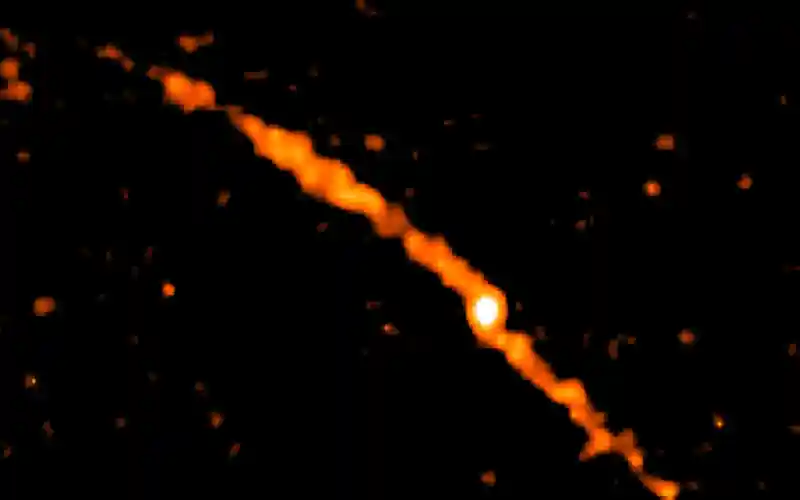
Palomar 5 is a diffuse stellar stream stretching roughly 30,000 light‑years across the sky and located about 80,000 light‑years from Earth. Unlike typical globular clusters, which are dense and spherical, Palomar 5 has a loose distribution of stars and an exceptionally long tidal tail. Globular clusters are often considered relics of the early Universe, containing hundreds of thousands of ancient stars formed from the same primordial gas cloud. The Milky Way hosts more than 150 such clusters, making them valuable tools for studying galactic history and dark matter.
Tidal streams, however, represent a different class of stellar structures. These elongated trails of stars were difficult to identify until the Gaia observatory mapped the Milky Way in unprecedented detail. Gaia’s precise measurements revealed numerous streams, though most lack an associated star cluster. Palomar 5 stands out as the only known case where a stream and a surviving cluster coexist.
Simulations Reveal a Hidden Black Hole Population
Researchers led by astrophysicist Mark Gieles used detailed N‑body simulations to reconstruct the evolution of Palomar 5. Their models included the possibility of black holes residing in the cluster’s core, based on recent evidence that such populations may exist in globular clusters. The simulations showed that interactions with these black holes could eject stars into the tidal stream, producing the structure observed today. This mechanism required a much larger number of black holes than previously predicted.
The team found that Palomar 5 may contain over 100 stellar‑mass black holes, each roughly 20 times the mass of the Sun. These objects would have formed early in the cluster’s history from supernova explosions of massive stars. As stars escape more easily than black holes, the cluster’s composition would gradually shift toward a black‑hole‑dominated core. According to the simulations, Palomar 5 will dissolve entirely within about a billion years, leaving only black holes orbiting the Milky Way.
Implications for Black Hole Formation and Cluster Evolution
The findings suggest that Palomar 5 may not be unique after all. Other globular clusters could follow similar evolutionary paths, eventually dissolving into tidal streams while retaining dense black hole populations. This scenario supports the idea that star clusters are fertile environments for forming binary black holes that later merge. Such mergers are a key source of gravitational‑wave signals detected by observatories like LIGO and Virgo.
Astrophysicist Fabio Antonini noted that estimating the number of black holes in clusters has been challenging because they cannot be observed directly. The new method offers a way to infer their presence by studying the stars they eject. Understanding these dynamics may help researchers identify clusters that host intermediate‑mass black holes, a long‑sought class of objects between stellar‑mass and supermassive black holes. The work also provides a framework for interpreting the growing number of stellar streams discovered across the Milky Way.
Palomar 5’s unusual structure has made it a target of interest for decades, but Gaia’s high‑precision data finally allowed researchers to model its evolution in detail. The cluster’s future dissolution mirrors the fate of many ancient systems orbiting the Milky Way, which are gradually torn apart by gravitational forces. As more streams are identified, astronomers expect to uncover additional remnants of disrupted clusters. These discoveries may help map the Milky Way’s gravitational field and reveal how its halo has grown over billions of years.
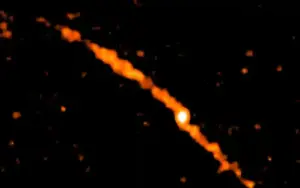
Our picture: Color-coded map of the distribution of stars emerging from the star cluster Palomar 5 (white blob); the two long tidal tails (orange) contain 1.3 times the mass of the cluster and delineate its orbit around the Milky Way Galaxy. Image credit: SDSS.