
New Evidence Sheds Light on Nubian King Qashqash
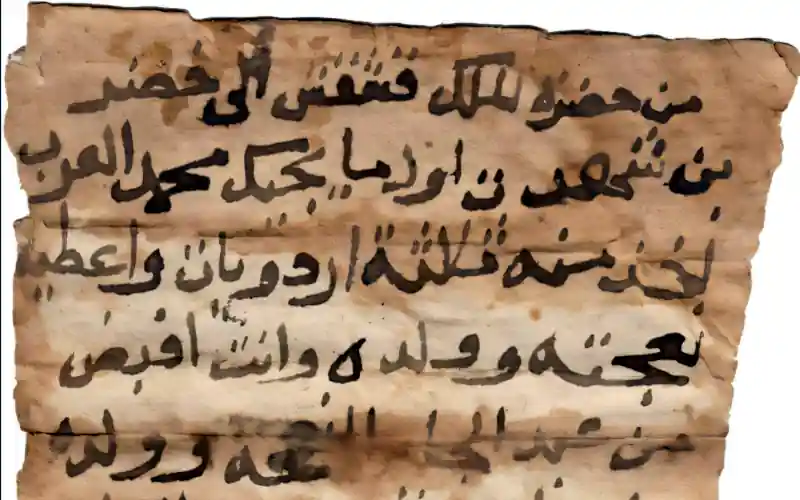
Letter from King Qashqash (detail)
- A newly analyzed Arabic document from a 17th‑century rubbish heap has provided the first concrete evidence of King Qashqash, a ruler previously considered semi‑legendary.
- The text offers rare insight into political authority, social exchange, and linguistic change in post‑medieval Dongola.
- Its discovery helps fill a major historical gap in a period often described as the “Dark Ages” of Old Dongola.
Revisiting Dongola’s Uncertain Past
Old Dongola once served as the capital of Makuria, a Christian kingdom in what is now northern Sudan. The city entered a long period of decline after the mid‑14th century, leaving historians with limited information about the next three centuries. This era saw gradual Arabization and Islamization, yet the pace and nature of these changes remained poorly understood. Recent research challenges the idea of a sudden cultural shift and instead highlights a long‑standing pattern of exchange across the Nile Valley.
Lead author Tomasz Barański emphasizes that Nubia historically functioned as a major corridor linking the Mediterranean and sub‑Saharan Africa. Goods such as gold, ivory, and enslaved people moved through the region, but so did technologies, religious ideas, and political models. Nubian communities actively shaped these interactions rather than simply absorbing outside influences. Understanding this dynamic helps contextualize later transformations, including the spread of Arabic language and Islamic culture.
A Rediscovered King Emerges From the Rubbish Heap
The UMMA project, launched in 2018, renewed archaeological work around Dongola’s citadel and nearby structures. Excavations at Building A.1, traditionally believed to be the residence of Dongola’s kings, uncovered elite materials such as silk, leather footwear, ivory objects, and a gold ring. More than 23 Arabic texts were also recovered, including an order issued in the name of King Qashqash. This document, found in a discarded pile of waste, provides the first direct evidence confirming his historical existence.
The letter outlines instructions from Qashqash to a man named Khiḍr, detailing the exchange of livestock and cotton goods. Its wording reflects a system of reciprocal gift‑giving consistent with Funj‑period practices. Linguistic analysis shows that the scribe used non‑standard Classical Arabic, including compressed lettering and simplified pronoun forms. These features suggest that Arabic was becoming the administrative language of the court even if it was not yet the everyday spoken language of Dongola.
New Clues About Governance and Social Networks
The document identifies Qashqash as the earliest known post‑medieval ruler of Dongola. It also hints at a structured communication network linking religious leaders, administrative officials, and possibly nomadic groups in the surrounding region. Barański notes that the circulation patterns of the recovered letters point to a coherent system of correspondence. This network appears to have supported both political authority and local micropolitics through gift exchange and negotiated relationships.
Among the items mentioned in the letter is a potential headdress, mandūf al‑raʾs, which was traditionally reserved for rulers and high nobility. Its inclusion reinforces the elite status of the individuals involved and provides insight into symbolic markers of authority. The discovery demonstrates how small fragments of written material can illuminate broader cultural and political dynamics. Archaeologists expect that further analysis of the remaining texts may reveal additional details about Dongola’s rulers and their interactions.
The find contributes to a growing body of evidence showing that discarded documents can be among the most valuable archaeological sources. Similar breakthroughs have occurred in other regions, such as the Cairo Geniza, where centuries of everyday writings transformed scholars’ understanding of medieval Jewish life. Nubia’s own documentary record is far more fragmentary, making each recovered text especially significant. As research continues, Dongola may yield further materials that reshape the historical narrative of post‑medieval Sudan.