
Unraveling the Mystery Behind a Super‑Bright Supernova
- A recently studied superluminous supernova is helping astrophysicists understand why some stellar explosions shine far brighter than typical supernovas.
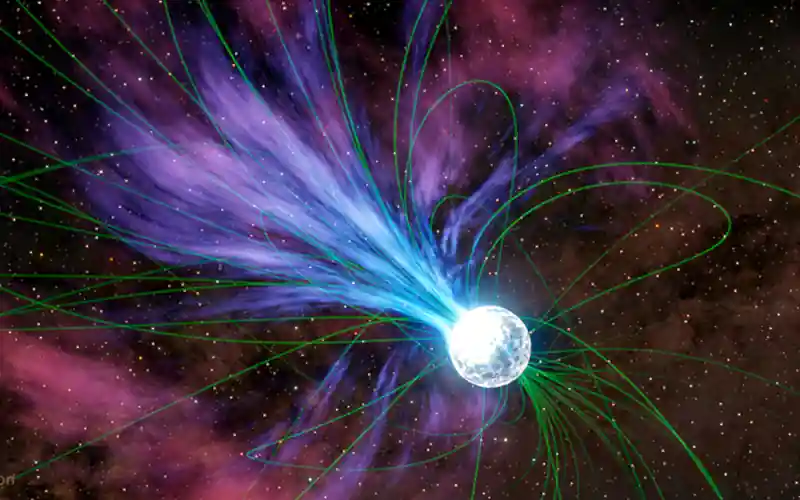
- Its unusual brightness appears to be powered by a rapidly spinning magnetar formed in the aftermath of the explosion.
- The findings offer new insight into how extreme stellar remnants shape the evolution of massive stars.
A Rare and Exceptionally Bright Stellar Explosion
Astrophysicists have long been intrigued by superluminous supernovas, a rare class of stellar explosions that outshine ordinary supernovas by factors of ten to one hundred. These events are already among the brightest in the universe, yet a small fraction reach luminosities that challenge existing models of stellar death. One such supernova, discovered in December 2024 in a galaxy roughly a billion light‑years away, has now provided researchers with valuable clues. Observations from the Las Cumbres Observatory and the ATLAS survey telescope in Chile enabled scientists to track its evolution in detail.
The team determined that the explosion’s extraordinary brightness was driven by a magnetar, an extremely dense and rapidly rotating neutron star with a powerful magnetic field. As the magnetar spun hundreds of times per second, it swept up charged particles and injected energy into the expanding cloud of gas and dust left behind by the star. This process significantly amplified the luminosity, making the event far brighter than a typical supernova. A magnetar forms only under specific conditions, when the collapsing core of a massive star avoids becoming a black hole.
Joseph Farah, a doctoral researcher at the Las Cumbres Observatory and the University of California, Santa Barbara, explained the underlying physics. He noted that when a massive star exhausts its nuclear fuel, gravity overwhelms the core, forcing protons and electrons to merge into neutrons. If the core’s mass remains below a critical threshold, a neutron star survives the collapse instead of forming a black hole. In this case, the newborn neutron star possessed the extreme magnetic and rotational properties required to become a magnetar.
How Magnetars Shape Superluminous Supernovas
The magnetar created in this explosion remained hidden at the center of the expanding debris. Its rapid rotation and magnetic field acted as an internal engine, continuously feeding energy into the surrounding material. This mechanism has been proposed since 2010 as a possible explanation for superluminous supernovas, but direct observational evidence has been limited. The new findings strengthen the case that magnetars are responsible for powering at least some of these unusually bright events.
Most supernovas follow a predictable pattern of brightening and fading, but this one displayed a series of brightness fluctuations over several months. These variations became shorter and more frequent as time passed, suggesting an underlying physical process affecting the energy output. Researchers attributed this behavior to Lense‑Thirring precession, a relativistic effect in which the rotation of a massive object twists the surrounding fabric of space‑time. After the explosion, the magnetar’s gravity pulled in some of the remaining stellar material, forming a disk that wobbled due to this precession.
This wobbling altered how energy transferred from the magnetar to the expanding supernova, producing the observed undulations in brightness. Andy Howell, an astrophysicist at the Las Cumbres Observatory and co‑author of the study, emphasized that the pattern matches predictions for magnetar‑powered supernovas. The first superluminous supernova was identified in 2006, and the magnetar hypothesis has gained traction since then. The new observations provide one of the clearest confirmations to date.
The Scale and Impact of Such Explosions
The original star that produced this supernova has not been precisely identified, but researchers believe it was extremely massive. Farah noted that it was likely dozens of times more massive than the sun and hundreds of thousands of times more luminous during its lifetime. Stars of this scale end their lives in dramatic fashion, releasing enormous amounts of energy in a matter of seconds. The resulting luminosity is difficult to comprehend, even when compared to familiar astronomical or terrestrial phenomena.
Farah illustrated this by comparing a typical supernova to a hypothetical hydrogen bomb detonated at point‑blank range. Even at the Earth–Sun distance of 93 million miles, a supernova would outshine such an explosion by nine orders of magnitude. A superluminous supernova, in turn, can be ten to one hundred times brighter than that already staggering output. In absolute terms, the supernova studied in this research briefly emitted more light than the entire Milky Way galaxy combined.
These findings deepen our understanding of how massive stars end their lives and how extreme objects like magnetars influence their surroundings. They also highlight the importance of long‑term monitoring, as the brightness fluctuations provided key evidence for the underlying physical processes. Continued observations of similar events may reveal whether magnetars are responsible for all superluminous supernovas or only a subset. Future studies could also clarify how often such massive stars form and collapse in this way.
One particularly intriguing aspect of this research is the role of Lense‑Thirring precession, a phenomenon predicted by Einstein’s general relativity but rarely observed so clearly in astrophysical explosions. Another interesting detail is that magnetars represent one of the densest forms of matter in the universe, with a teaspoon of their material weighing billions of tons. Finally, the fact that this single supernova briefly outshone an entire galaxy underscores how extreme and energetic the deaths of massive stars can be, offering a dramatic window into the physics of the early universe.