
Rubin Observatory to Spot Impactors Earlier

This artist's illustration shows asteroids moving in Earth's vicinity. The Vera Rubin Observatory's Legacy Survey of Space and Time will detect many more small rocks that are about to strike Earth, giving ample time for follow-up observations with other telescopes. Not only does this mean we'll learn more about the Near Earth Object population, but we will be able to recover more of them. Credit: ESA/P.Carril
- The Rubin Observatory’s upcoming survey will significantly improve early detection of small near‑Earth impactors.
- Its simulations show that the facility could identify objects days before they reach Earth.
- The findings suggest major advances in planetary defense and NEO characterization.
A New Era for Near‑Earth Object Detection
The Vera Rubin Observatory (VRO) is still preparing for full operations, yet its scientific potential is already becoming clearer. While much attention has focused on its contributions to cosmology and transient astronomy, new research highlights its value for studying objects much closer to Earth. The observatory’s Legacy Survey of Space and Time (LSST) is expected to detect millions of asteroids and tens of thousands of near‑Earth objects (NEOs). This capability positions the VRO as a major contributor to planetary defense efforts.
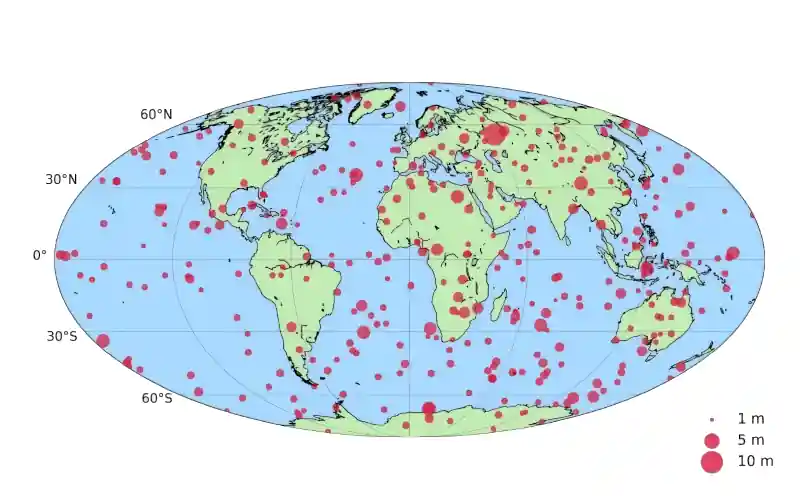
A recent study led by Ian Chow from the University of Washington examines how effectively the LSST will detect imminent impactors. These are small natural objects discovered shortly before entering Earth’s atmosphere, offering rare opportunities to study them as asteroids, meteors and meteorites. The researchers used NASA’s Center for NEO Studies database to simulate 343 previously recorded meter‑scale impactors. Their goal was to understand how early the LSST could detect similar objects before they strike Earth.
The team relied on Sorcha, a survey simulator that models how the Rubin Observatory will perform under realistic observing conditions. By recreating the pre‑impact trajectories of the 343 objects, they assessed how often the LSST would spot them in time for meaningful follow‑up observations. Their results indicate that the observatory could detect one or two such objects per year. This would roughly double the current global detection rate for imminent impactors.
Simulations show that the median discovery time for these objects would be about 1.57 days before impact. The median time of first observation would be around 3.06 days prior to impact, offering a modest but valuable improvement over current capabilities. Historically, the longest warning time for an imminent impactor has been only 21 hours. Some simulated cases, however, were detected weeks in advance, demonstrating the LSST’s potential for early alerts.
Improving Global Coverage and Warning Times
Current detection efforts are heavily biased toward the northern hemisphere, where most capable observatories are located. This geographic imbalance limits the ability to identify impactors approaching from southern skies. The Rubin Observatory, situated in Chile, will help correct this bias by providing extensive southern hemisphere coverage. Its location therefore adds an important complementary perspective to existing surveys.
The study’s simulations show a trend toward detecting more southern hemisphere impactors, reflecting the observatory’s vantage point. This shift will broaden the range of objects that can be identified before they reach Earth. Additional warning time will also allow astronomers to gather more detailed information about each object. Observations could include measurements of albedo, rotation, surface roughness and compositional characteristics.
Radar observations may also become more feasible with earlier detection. These techniques can reveal fine‑scale details about an object’s shape and structure, which are difficult to obtain under time pressure. Longer observational arcs will improve trajectory calculations, enabling more accurate predictions of impact locations. This precision is essential for meteorite recovery efforts, which depend on knowing where fragments are likely to land.
A previous case from 2023 demonstrated the value of rapid follow‑up observations. Researchers were able to match the predicted trajectory of impactor 2023 CX1 to its observed fireball path within 18 meters. Such accuracy is rare but shows what is possible when detection and follow‑up occur quickly. The LSST’s extended warning times could make similar results more common.

Scientific and Planetary Defense Benefits
Most small impactors fall over oceans or remote regions, making meteorite recovery difficult or impossible. Even so, advance warnings still provide scientific value. Airborne dust sampling could be deployed to collect material from atmospheric fireballs when ground recovery is not feasible. These samples would offer insights into the composition of small NEOs that are otherwise inaccessible.
The researchers emphasize that their estimate of one or two detections per year is a lower limit. As the LSST begins operations, its ability to detect faint, fast‑moving objects may exceed expectations. For the first time, astronomers will be able to observe meter‑scale impactors in space before they enter the atmosphere. This capability represents a major step forward in understanding the diversity of small NEOs.
More importantly, the LSST’s early detection of larger, rarer impactors could have significant implications for planetary defense. Longer warning times would enable coordinated global observation campaigns. These efforts could refine orbital calculations, improve impact predictions and support meteorite recovery. The study concludes that the LSST will play a central role in future impactor monitoring and response strategies.
An interesting detail is that the Rubin Observatory’s alert system is designed to issue up to ten million alerts per night once fully operational, making it one of the most data‑intensive astronomical facilities ever built.