
Lenovo advances workstation lineup with new AI hardware
- Lenovo has unveiled new ThinkPad and ThinkStation P Series workstations built for AI‑focused workloads.
- The lineup includes updated mobile and desktop systems with NVIDIA’s latest RTX PRO Blackwell GPUs and dedicated NPUs.
- A new silicon‑anode battery concept also points toward improved efficiency in future Lenovo laptops.
Next‑generation workstations built for AI workloads
Lenovo’s latest workstation portfolio targets professionals who rely on local AI processing, including engineers, data scientists and creative specialists. The new ThinkPad P Series and ThinkStation P5 Gen 2 models integrate next‑generation Intel Core Ultra Series 3 processors, AMD Ryzen AI PRO 400 Series chips and NVIDIA RTX PRO Blackwell GPUs. These components work together with dedicated NPUs to accelerate tasks such as model inference, data analysis and visualization. Lenovo positions these systems as part of its broader Hybrid AI Advantage strategy developed in collaboration with NVIDIA.
The company says the new workstations are designed to support demanding workflows like CAD, BIM, rendering and AI development. Each model aims to reduce the time between input and output by handling more processing locally rather than relying on cloud resources. This approach can benefit users who work in environments with limited connectivity or strict data‑handling requirements. Lenovo emphasizes that the systems are intended to scale from student use cases to enterprise‑level engineering workloads.
Tom Butler, Vice President of Lenovo’s Intelligent Devices Group, noted that professionals increasingly need hardware capable of adapting to varied AI tasks. He highlighted mobility, performance and expandability as key requirements across different user groups. Lenovo’s updated lineup attempts to address these needs through a mix of lightweight mobile systems and high‑performance desktop configurations. The company frames these devices as foundational to its hybrid AI strategy.
The announcement includes six new workstation models: the ThinkPad P14s i Gen 7, ThinkPad P14s Gen 7 AMD, ThinkPad P16s i Gen 5, ThinkPad P16s Gen 5 AMD, ThinkPad P1 Gen 9 and the ThinkStation P5 Gen 2. Each system targets a different segment of the professional market. Lenovo plans to showcase these devices at NVIDIA GTC 2026 in San Jose. Visitors will be able to see several of the new models at the company’s booth.
Mobile workstation lineup: lighter designs with stronger AI acceleration
The ThinkPad P14s Gen 7 is the smallest and lightest model in the new lineup. It offers a 14‑inch form factor with either Intel Core Ultra Series 3 processors paired with NVIDIA RTX PRO Blackwell GPUs or AMD Ryzen AI PRO 400 Series processors with Radeon 890M graphics. This configuration aims to provide workstation‑class performance in a portable chassis. Lenovo positions the P14s Gen 7 as a suitable option for students and professionals who need mobility without sacrificing capability.
The ThinkPad P16s Gen 5 expands on this concept with a larger 16‑inch display and increased performance headroom. It can be configured with the same Intel or AMD processors and supports NVIDIA’s RTX PRO Blackwell Laptop GPU for more demanding visualization tasks. The system weighs under 1.76 kg, making it relatively lightweight for its class. Lenovo designed the P16s Gen 5 for engineers and designers who frequently work on the move.
For users who require higher performance, the ThinkPad P1 Gen 9 offers a more powerful configuration. It includes an Intel Core Ultra Series 3 processor with up to 16 cores and a discrete NVIDIA RTX PRO Blackwell GPU. Lenovo states that the system can deliver up to 672 TOPS of AI performance, making it suitable for rendering, color‑critical workflows and advanced visualization. The P1 Gen 9 maintains a thin design despite its higher performance capabilities.
All mobile models include Lenovo’s ThinkShield security suite, which provides BIOS‑level protections, secure wipe features and privacy controls. The devices also incorporate recycled materials and meet several environmental certifications, including EPEAT Gold and ENERGY STAR 9.0. Lenovo has improved serviceability by adding more customer‑replaceable components. These updates aim to extend the lifespan and maintainability of the systems.
ThinkStation P5 Gen 2: a desktop built for heavy computation
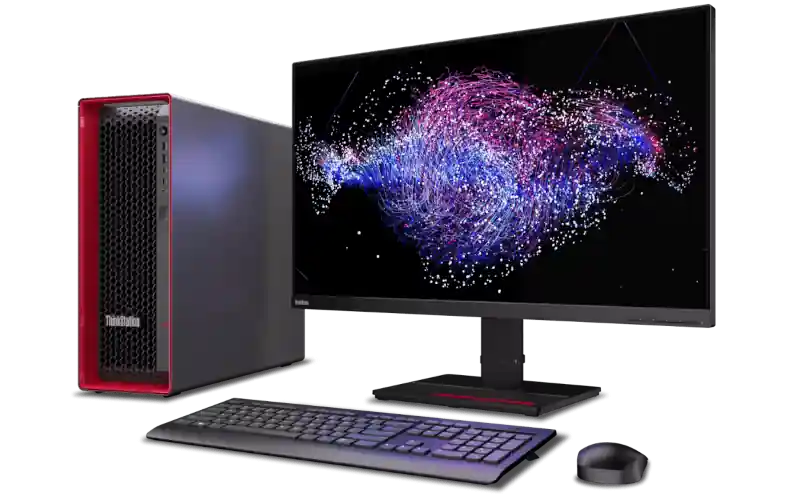
The ThinkStation P5 Gen 2 serves as the desktop counterpart to Lenovo’s mobile workstation lineup. It is equipped with Intel Xeon 600 processors and supports up to two NVIDIA RTX PRO 6000 Blackwell Max‑Q GPUs. This configuration targets compute‑intensive workloads such as molecular modeling, medical imaging and high‑resolution rendering. Lenovo positions the P5 Gen 2 as a versatile option for VFX artists, AI developers and scientific researchers.
The system is designed for scalability, allowing users to expand memory, storage and GPU capacity as their workloads grow. Lenovo also highlights its support for NVIDIA OpenShell, an open‑source runtime environment aimed at improving security and privacy for autonomous agent development. The workstation will also support NVIDIA NemoClaw, a stack designed to simplify the deployment of always‑on AI assistants. These additions reflect Lenovo’s focus on enabling advanced AI workflows directly on workstation hardware.
Security remains a central theme across Lenovo’s desktop and mobile offerings. The ThinkStation P5 Gen 2 includes hardware‑level protections and firmware safeguards to help secure sensitive data. Lenovo emphasizes that these features are essential for industries that handle confidential information. The company aims to provide a consistent security framework across its entire workstation portfolio.
The P5 Gen 2’s combination of Xeon processors and dual Blackwell GPUs positions it as one of Lenovo’s most capable desktop systems to date. It is intended for users who need sustained performance for long‑running simulations or rendering tasks. Lenovo’s design also prioritizes reliability, which is critical for professional environments. The workstation’s expandability ensures it can adapt to future workload requirements.
Silicon‑anode battery concept signals future efficiency gains
Lenovo also introduced a proof‑of‑concept silicon‑anode battery called ED1000, which it describes as the world’s first 1,000Wh/L battery designed for notebooks and workstations. The company says the technology offers more than a 10% improvement in energy density compared to previous generations. With a capacity of up to 99.9Wh in a standard laptop footprint, the battery could enable longer runtimes without increasing device size. Lenovo developed the technology in collaboration with Shanghai Jiao Tong University.
The ED1000 battery concept reflects Lenovo’s interest in improving both performance and efficiency in future mobile workstations. Higher energy density could allow manufacturers to design thinner devices without compromising battery life. It may also support more power‑hungry components, such as advanced GPUs and NPUs. Lenovo suggests that the technology could influence future form factors across its workstation lineup.
Although the battery remains a proof of concept, its potential impact is significant. Silicon‑anode technology has long been viewed as a promising advancement for lithium‑ion cells. Lenovo’s announcement indicates progress toward commercial viability. The company has not provided a timeline for when the technology might appear in shipping products.
The introduction of the ED1000 battery aligns with Lenovo’s broader focus on hybrid AI workflows. More efficient power solutions could help support on‑device AI processing without compromising mobility. The concept also highlights Lenovo’s ongoing investment in research partnerships. Future workstation generations may benefit from these developments as the technology matures.
Silicon‑anode batteries have been a major research focus across the tech industry because they can theoretically store far more energy than traditional graphite‑based cells. Lenovo’s proof‑of‑concept suggests that the technology is moving closer to practical implementation, which could influence not only laptops but also electric vehicles and other high‑capacity battery applications.