
China’s BCI Push Still Trails Neuralink
- China’s leading state‑backed brain‑computer interface firm says its most advanced implant remains three years behind Neuralink.
- The company is expanding trials as Beijing accelerates its national BCI strategy.
- Its progress highlights both rapid development and the gap that still separates it from U.S. competitors.
China’s state‑supported brain‑computer interface (BCI) sector is moving quickly, yet its top developers acknowledge they remain behind the field’s most prominent U.S. player. NeuCyber Neurotech, a Beijing‑affiliated startup, said its latest invasive BCI system is still roughly three years behind Neuralink’s technology. The company’s Beinao‑2 implant uses flexible electrodes that fully enter the brain and is currently undergoing large‑scale animal testing. Executives say the device represents their most ambitious effort to date, but it has not yet reached human trials.
Neuralink’s advantage stems largely from its surgical robot, which can insert hundreds of electrodes into the brain within minutes. This capability has enabled the company to move faster through clinical stages and accumulate more patient data. NeuCyber’s rotating CEO Li Yuan noted that Neuralink already has more than 20 human participants using its N1 chip. She said this level of clinical experience places the U.S. firm several years ahead in practical deployment.
Li explained that NeuCyber must still complete animal studies before moving into early‑feasibility human trials. These steps are required before regulators will authorize broader clinical testing. The company expects real trials for Beinao‑2 to begin in about two years if progress continues as planned. Such a timeline underscores the complexity of developing invasive neural implants and the regulatory scrutiny surrounding them.
China’s Strategic Push Into Brain‑Computer Interfaces
Beijing has elevated BCIs to a core strategic industry in its latest five‑year plan. The technology now sits alongside quantum computing, embodied AI and nuclear fusion as areas the government considers essential for future competitiveness. China’s regulators recently approved the world’s first commercial invasive BCI medical device, marking a significant milestone for the sector. The approved implant, developed by Shanghai‑based Neuracle, is a coin‑sized wireless device that rests on the brain’s outer membrane and controls a robotic glove for patients with spinal cord injuries.
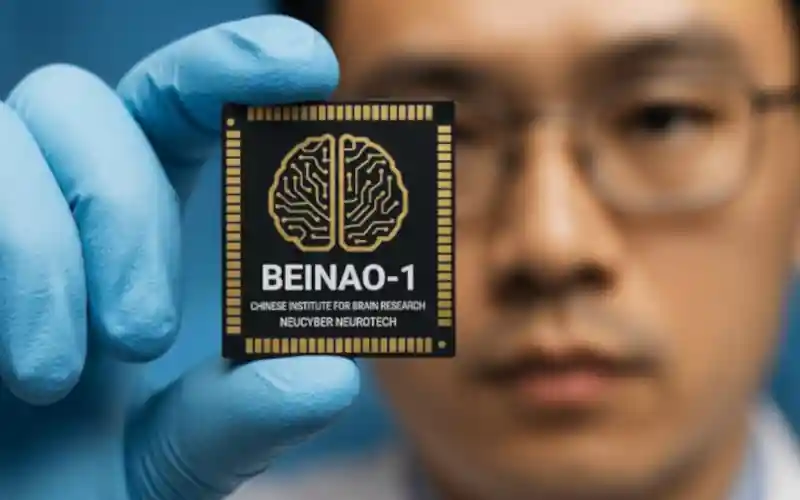
NeuCyber has already completed seven human implantations of its earlier Beinao‑1 system. This semi‑invasive device uses a mesh of electrodes placed on the brain’s outer membrane rather than penetrating deeper tissue. Patients included individuals with quadriplegia who reported improvements in hand motor function after months of use. Some were also able to remotely control computer cursors, demonstrating the system’s potential for assistive applications.
The company aims to expand Beinao‑1 clinical trials to 50 patients this year. Achieving that scale would be a major step toward regulatory approval for commercial use. NeuCyber’s chief scientist previously told Reuters that such an expansion would position Beinao‑1 as the BCI implant with the highest number of patients worldwide. This would reflect China’s determination to close the gap with leading foreign developers.
Comparing NeuCyber and Neuralink’s Clinical Progress
Neuralink currently has 21 participants enrolled in human trials globally. The company announced earlier this year that its first patient was able to control a computer cursor using thought alone, a milestone that drew international attention. NeuCyber hopes to reach similar capabilities as its products advance through testing. Li estimates that it may take two to three years before NeuCyber’s devices become widely available in China, pending approval from health authorities, insurance regulators and medical device agencies.
The company plans to focus on restoring motor function for patients with spinal cord injuries once its devices reach the market. This aligns with global BCI research trends, which prioritize medical applications before consumer‑oriented uses. NeuCyber has received approximately 200 million yuan (about $29 million) in funding from the Beijing government to support its development. Such investment signals strong state interest in accelerating domestic BCI innovation.
China’s rapid progress in BCI research reflects a broader national effort to compete in emerging technologies. Government support has helped local firms scale quickly, though invasive neural implants remain a technically demanding field. Regulatory approval for Neuracle’s device suggests that China is willing to move faster than other countries in authorizing clinical use. This approach may give domestic companies more opportunities to gather real‑world data.
China’s approval of an invasive BCI device for commercial use is unprecedented globally. The United States has not yet authorized any similar implant for market release, despite Neuralink’s clinical progress. This regulatory difference could influence how quickly each country’s BCI ecosystem evolves over the next decade.