
A Star That Defies Expectations
WOH G64
- Astronomers have documented an unusual transformation in WOH G64, one of the universe’s most massive known stars.
- Long-term observations show the star shifting from a red supergiant to a yellow hypergiant without any explosive event.
- The phenomenon challenges existing stellar evolution models and may help clarify how the most massive stars end their lives.
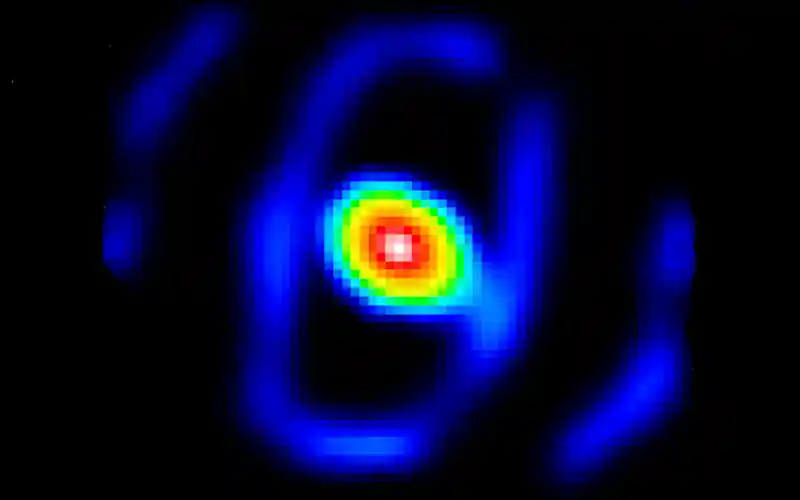
WOH G64, located in the Large Magellanic Cloud about 160,000 light-years from Earth, has displayed behavior not previously observed in a star of its size. The object is roughly 28 times the mass of the Sun and ranks among the largest known stars in the universe. Its luminosity is estimated at about 300,000 times that of the Sun, and its diameter would stretch between the orbits of Jupiter and Saturn if placed at the center of our solar system. Astronomers have monitored it for more than three decades, and the latest findings reveal a rapid and unexpected shift in its physical characteristics.
A Rapid and Unexplained Transformation
In 2014, researchers detected a notable change in the star’s color, indicating a rise in surface temperature. WOH G64 transitioned from an extreme red supergiant to a yellow hypergiant, a shift that typically unfolds over far longer timescales. The change occurred without signs of an eruption or explosion, which are usually the only stellar events observable on human timescales. According to lead researcher Gonzalo Muñoz‑Sanchez, no current stellar model fully accounts for this transformation.
The star is estimated to be around 10 million years old, placing it near the end of its life cycle. By comparison, the Sun is 4.5 billion years old and has billions of years remaining. Massive stars between eight and 23 solar masses usually end as supernovae after passing through a red supergiant phase. For stars between 23 and 30 solar masses, however, the final stages remain uncertain, and WOH G64 may offer crucial insight into this poorly understood range.
A Binary System Adds Complexity
Observations also indicate that WOH G64 is part of a binary system, gravitationally bound to an unidentified companion star. The characteristics of this companion remain unknown, but its presence complicates the interpretation of the observed changes. Interactions between the two stars may have temporarily altered WOH G64’s appearance, potentially mimicking the traits of a red supergiant. Researchers also propose that the star may be returning to a stable yellow state after a violent episode that occurred before systematic observations began.
The possibility of a future merger between the two stars cannot be ruled out. Such an event would significantly influence the system’s evolution and could produce additional unusual behavior. Continued monitoring will be essential to determine whether the recent transformation is part of a longer cycle or a singular event. Astronomers expect that further data will help refine models of how massive stars evolve and die.
Implications for Stellar Evolution
WOH G64’s behavior may help resolve long-standing questions about the fate of the most massive stars. Some may explode as supernovae, while others could collapse directly into black holes without a visible explosion. The star’s rapid shift from red to yellow suggests that intermediate evolutionary phases may be more dynamic than previously assumed. If confirmed, this could reshape how scientists interpret the life cycles of stars at the upper mass limits.
The research team emphasizes that the star’s unusual evolution challenges existing theoretical frameworks. As observations continue, WOH G64 may become a key reference point for understanding the final stages of stellar life in high‑mass systems. Its proximity in astronomical terms makes it an accessible target for long-term study. The findings were published in Nature Astronomy, highlighting the significance of the discovery within the scientific community.
Recent studies of massive stars suggest that rapid, unpredictable changes may be more common than previously believed. Yellow hypergiants, for example, are extremely rare and often represent short-lived transitional phases. Some researchers propose that such stars may undergo repeated cycles of expansion and contraction before their final collapse. WOH G64’s behavior may therefore be part of a broader pattern that is only now becoming observable thanks to decades-long monitoring campaigns.