A Strange Discovery in a Familiar Nebula
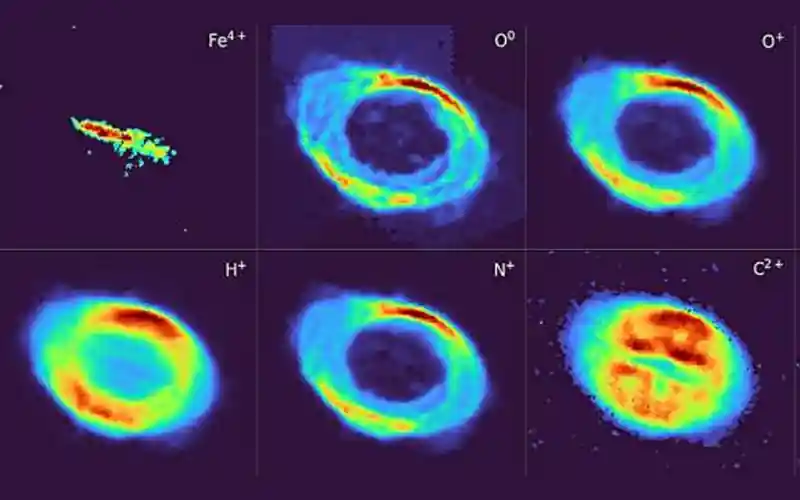
- Cloud of iron atoms stretches across Ring Nebula’s face.
- It is possible it is remnants of vaporized rocky planet.
- Nebula discovered in 1779 by French astronomer Messier.
A New Feature in a Well‑Studied Object
The Ring Nebula has been a staple of astronomical observation since Charles Messier cataloged it in 1779, yet recent research shows it still holds surprises. Astronomers have detected a vast bar‑shaped cloud of iron atoms stretching roughly 3.7 trillion miles across its face. This nebula, a glowing shell of gas and dust expelled by a dying star, has long been considered well understood. The newly observed structure challenges that assumption and raises questions about its origin.
Researchers say the mass of iron is comparable to that of Earth’s molten core. One hypothesis suggests the material could be the remains of a rocky planet vaporized when the nebula’s central star shed its outer layers. Such a fate may await the inner planets of our own solar system when the sun reaches a similar stage billions of years from now. Scientists caution, however, that this explanation remains speculative until more data is gathered.
The discovery was made using WEAVE, a new instrument on the William Herschel Telescope in the Canary Islands. WEAVE’s capabilities allowed astronomers to examine the nebula in greater detail than before. Lead researcher Roger Wesson of Cardiff University and University College London said the finding demonstrates how even familiar objects can reveal unexpected features when observed with new tools. He noted that the Ring Nebula remains a popular target for both professional and amateur astronomers.
Why the Iron Bar Is So Unusual
The Ring Nebula, also known as Messier 57, lies about 2,600 light‑years away in the constellation Lyra. Formed roughly 4,000 years ago, it is considered a relatively young planetary nebula in cosmic terms. Its ring‑like appearance is easily visible through small telescopes, making it a common subject in astronomy textbooks. This familiarity is part of what makes the iron bar so striking.
Study co‑author Janet Drew of University College London emphasized that no other detected element appears in the same bar‑shaped configuration. She described the feature as “weird” and noted that its significance lies in the absence of any straightforward explanation. The idea that a vaporized planet produced the iron remains plausible but unproven. Researchers acknowledge that alternative processes could also account for the structure.
Wesson added that while a planet like Earth contains enough iron to form such a bar, there is no clear mechanism that would arrange the material into this shape. The nebula itself formed when a star about twice the mass of the sun exhausted its nuclear fuel. It expanded into a red giant before shedding its outer layers and collapsing into a white dwarf roughly the size of Earth. The expelled material now forms the glowing structure we observe.
From Earth’s perspective, the nebula appears ring‑shaped, though astronomers believe it is actually a cylinder viewed end‑on. Its composition is mostly hydrogen and helium, with smaller amounts of heavier elements. Roughly 3,000 similar nebulas are known in the Milky Way. Studying them helps scientists understand how stars distribute newly forged elements into space, contributing to future generations of stars and planets.
What Comes Next for Researchers
The discovery of the iron bar opens new avenues for studying the late stages of stellar evolution. Astronomers hope to gather additional data to determine how the structure formed and whether similar features exist in other nebulas. WEAVE’s advanced capabilities will play a key role in these follow‑up observations. Researchers aim to compare the Ring Nebula’s composition with that of other planetary nebulas to identify potential patterns.
Understanding the origin of the iron bar could also shed light on the fate of planetary systems around dying stars. If the feature does come from a destroyed planet, it may offer a rare glimpse into the final moments of worlds orbiting aging suns. Alternatively, the structure could point to previously unknown processes occurring during the formation of planetary nebulas. Either outcome would expand current models of stellar evolution.
Wesson said the team looks forward to collecting more data to unravel the mystery. He emphasized that the discovery highlights the value of revisiting well‑known objects with new instruments. The Ring Nebula’s iron bar may ultimately reveal insights into both stellar death and planetary destruction. For now, it remains one of the most intriguing astronomical puzzles of recent years.
Planetary nebulas like the Ring Nebula are often used to study how stars enrich the galaxy with heavy elements. These elements, forged in stellar interiors, eventually become part of new stars, planets and even life‑forming materials. The Ring Nebula itself was one of the first objects photographed by the James Webb Space Telescope in 2023, producing some of the most detailed images ever captured of a planetary nebula.