
Ancient Fossil Reveals One of the First Plant‑Eating Animals
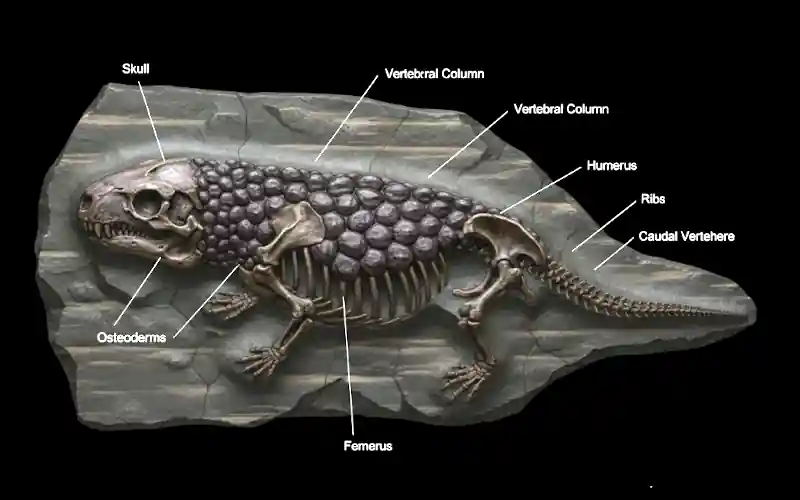
- Researchers in Canada have identified a 307‑million‑year‑old skull belonging to one of the earliest known plant‑eating land vertebrates.
- The animal, named Tyrannoroter heberti, shows clear anatomical adaptations for processing tough vegetation.
- Its discovery sheds new light on how early tetrapods diversified into ecological roles that still shape modern ecosystems.
A Rare Glimpse Into Early Herbivorous Tetrapods
Scientists have uncovered the skull of Tyrannoroter heberti in Nova Scotia, dating back roughly 307 million years. The fossil represents one of the earliest vertebrates known to have adapted to a plant‑based diet. Its triangular skull structure supported large cheek muscles capable of crushing and grinding fibrous vegetation. Researchers estimate the animal measured about 30 centimeters long and resembled a stocky lizard, similar in build to a modern blue‑tongued skink.
Although Tyrannoroter looked reptile‑like, it belonged to a group called microsaurs rather than true reptiles. These small, early tetrapods lived during the Carboniferous Period, a time when lush forests dominated the landscape. The species was part of a lineage that eventually gave rise to amphibians, reptiles, mammals and birds. Its discovery helps fill a gap in understanding how early land vertebrates diversified their diets.
The earliest tetrapods were carnivorous, feeding primarily on other animals. Over time, some shifted toward insect‑eating before eventually adapting to consume plants. Tyrannoroter provides evidence of this transition, showing that herbivory emerged earlier than previously thought. Its specialized teeth and jaw structure indicate a clear ability to process high‑fiber plant material.
Anatomy Built for Eating Tough Vegetation
The skull of Tyrannoroter measures about 10 centimeters and displays several traits associated with plant‑eating. A downturned snout appears optimized for clipping low‑lying vegetation. Large internal chambers housed powerful jaw muscles needed to break down tough plant fibers. Most notably, the animal possessed opposing dental fields—one on the palate and one on the lower jaw—that fit together like grinding plates.
These “dental batteries” are seen in other herbivorous animals and allow efficient processing of vegetation. CT scans revealed dozens of conical teeth on the roof of the mouth, further supporting its plant‑focused diet. While the species may have also eaten insects, its anatomy suggests a stronger adaptation to fibrous plants than similar animals from the same period. Researchers compare it to Melanedaphodon, another early tetrapod, but note that Tyrannoroter was better equipped for handling tougher plant matter.
The genus name means “tyrant digger,” referencing both its relatively large size for the era and its likely burrowing behavior. Its species name honors Brian Hebert, who discovered the fossil embedded in a cliff on Cape Breton Island. The find adds to a growing body of evidence that early tetrapods occupied a wider range of ecological niches than once assumed.
Implications for Understanding Early Ecosystems
The discovery challenges long‑held assumptions about when vertebrate herbivores first appeared. Scientists previously believed that true plant‑eating tetrapods emerged near the end of the Carboniferous Period, around 299 million years ago. Tyrannoroter pushes that timeline back by several million years. Its existence suggests that early land ecosystems already included herbivore‑dominated food webs similar to those seen today.
Paleontologist Arjan Mann notes that the fossil shows how quickly tetrapods diversified after moving onto land. The shift from carnivory to insectivory and eventually herbivory reflects a gradual expansion into new ecological roles. Eating early plant‑eating insects may have helped tetrapods develop the gut flora needed to digest vegetation. This progression highlights the complex interplay between diet, anatomy and environment during early vertebrate evolution.
The Carboniferous forests where Tyrannoroter lived were dense and resource‑rich, providing ample plant material. These ecosystems later formed much of the world’s coal deposits. The emergence of herbivores in such environments would have influenced plant evolution and ecosystem structure. The fossil offers a rare window into how these ancient communities functioned.
Microsaurs, the group to which Tyrannoroter belongs, were once thought to be evolutionary dead ends. Recent research, however, suggests they played a more significant role in early tetrapod diversity. Their fossils are helping scientists reconstruct how early land vertebrates adapted to new habitats and diets during a transformative period in Earth’s history.