Ancient Fossil Suggests Early Human Bipedalism
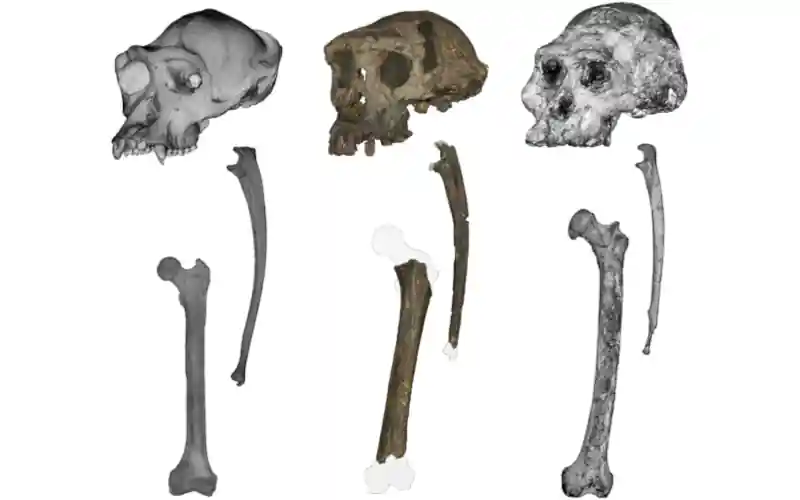
Crania, ulnae, and femora of (left to right): a chimpanzee, Sahelanthropus, and Australopithecus. Credit: Scott Williams/NYU and Jason Heaton/University of Alabama Birmingham
- A new study indicates that a seven‑million‑year‑old fossil may push the origins of upright walking far earlier than previously believed.
- Researchers found strong anatomical evidence that Sahelanthropus tchadensis was capable of bipedal movement despite its ape‑like appearance.
- The findings could reshape scientific understanding of when and how the earliest human ancestors began walking on two legs.
New Evidence Points to Early Upright Walking
Scientists have long debated whether Sahelanthropus tchadensis, a species discovered in the early 2000s, could walk upright. The latest study presents compelling anatomical evidence that this ancient hominin used bipedal posture on the ground. Researchers identified a femoral tubercle, a small structure that anchors the iliofemoral ligament, which is essential for upright walking and found only in human ancestors. Additional traits in the leg and hip further support the conclusion that the species moved confidently on two legs.
Advanced 3D imaging and detailed bone analysis helped confirm these findings. The research team also identified several other features associated with bipedal locomotion. These include muscle attachment patterns and joint structures consistent with early hominins. Despite its small brain and ape‑like skull, Sahelanthropus appears to have combined tree‑climbing abilities with ground‑based walking.
Lead author Scott Williams described the species as a “bipedal ape” that likely spent significant time in trees while still using upright movement on the ground. His team included researchers from New York University, the University of Washington, Chaffey College and the University of Chicago. Their work was published in Science Advances. The findings add new weight to the argument that bipedalism emerged very early in the human lineage.
The study suggests that upright walking may have evolved close to the root of the human family tree. This challenges earlier assumptions that bipedalism developed later in hominin evolution. The discovery also highlights how small skeletal features can reveal major evolutionary transitions. Researchers say the evidence is strong enough to reopen discussions about the earliest stages of human development.
Revisiting a Long‑Debated Fossil
Sahelanthropus was first uncovered in Chad’s Djurab desert, where early research focused mainly on its skull. That focus left many questions unanswered about how the species moved. Later discoveries of arm and leg bones reignited debate over whether the fossil represented a true human ancestor. The new study revisits these bones using modern analytical techniques.
Researchers compared the ulnae and femur with bones from both living species and fossil hominins. They used 3D geometric morphometrics to analyze subtle differences in bone shape. This method allowed them to identify traits that align more closely with early human ancestors than with apes. One of the comparison species was Australopithecus, known from the famous “Lucy” skeleton.
Three key indicators of bipedalism emerged from the analysis. The femoral tubercle, femoral antetorsion and gluteal muscle structure all point toward upright walking. Earlier studies had suggested some of these traits, but the new research confirms their presence with greater precision. Together, they form a consistent picture of a species adapted for bipedal movement.
The researchers also examined limb proportions for additional clues. Sahelanthropus had a relatively long femur compared to its ulna, a pattern more typical of hominins than apes. Although its legs were shorter than those of modern humans, the proportions resemble those of Australopithecus. This intermediate form suggests a transitional stage in the evolution of upright walking.
Implications for Human Evolution
The study’s findings strengthen the case that Sahelanthropus tchadensis belongs within the hominin lineage. If confirmed, it would represent the earliest known species capable of upright walking. This would push the origins of bipedalism back to around seven million years ago. Such a timeline places bipedalism near the very beginning of human evolution.
Understanding when upright walking emerged is central to reconstructing the human family tree. Bipedalism is one of the defining traits of hominins and shaped later evolutionary developments. The new evidence suggests that early ancestors may have combined tree‑climbing with ground‑based walking for long periods. This mixed locomotion could have influenced how later species adapted to changing environments.
The research team emphasizes that their findings rely on multiple independent analyses. Each analysis detected the same anatomical signals supporting bipedalism. This consistency increases confidence in the results. The study also highlights the importance of revisiting older fossils with modern tools.
Future research may focus on uncovering additional fossils from the same region. More complete skeletons could help clarify how Sahelanthropus balanced life in trees with movement on the ground. The study’s authors hope their work will encourage further exploration of early hominin evolution. Their findings underscore how much remains to be discovered about the origins of human mobility.
Sahelanthropus tchadensis was discovered thousands of kilometers west of the East African Rift Valley, where most early hominin fossils have been found. Its location suggests that early human evolution may have been more geographically widespread than previously assumed. This challenges long‑held ideas about where the earliest stages of human ancestry unfolded. The discovery may prompt researchers to expand their search for ancient hominins beyond traditional fossil hotspots.