
Ancient Marks Hint at Early Symbol Systems
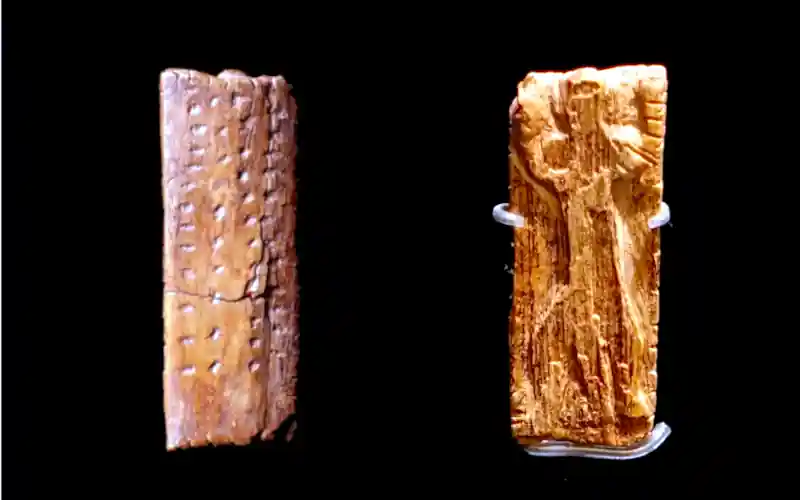
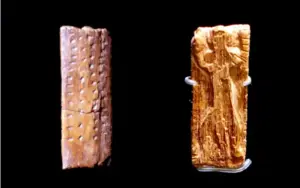
A figurine called Adorant from Geissenkloesterle Cave, located near the town of Blaubeuren in the state of Baden-Wuerttemberg, made approximately 40,000 years old and consisting of a small ivory plate bearing an anthropomorphic figure and multiple sequences of notches and dots, is displayed, in Stuttgart, Germany
- New research suggests that 40,000‑year‑old artifacts from Germany may contain structured sequences of symbols used by early humans.
- The markings do not constitute writing but show similarities to proto‑cuneiform, one of the earliest known script systems.
- These findings point to unexpectedly advanced cognitive abilities among Europe’s earliest modern human cultures.
Symbolic Marks Found on Ice‑Age Artifacts
A small mammoth‑ivory figurine known as the Adorant, discovered in 1979 in a German cave, features sequences of notches and dots carved roughly 40,000 years ago. Similar markings appear on numerous objects created by the same Aurignacian culture, which represents some of the earliest modern humans in Europe. Researchers examined these symbols to determine whether they might represent a precursor to written language. Their analysis suggests the marks fall short of writing but show structured patterns that go beyond simple decoration.
The figurine depicts a hybrid lion‑human figure and measures about 38 by 14 millimeters. Its markings, along with those on more than 200 other artifacts, include notches, dots, lines, crosses and star shapes. These objects were found in four cave sites in southwestern Germany and date from 43,000 to 34,000 years ago. The researchers focused on how these signs were arranged and whether their patterns resembled later symbolic systems.
Statistical Analysis Reveals Structured Use
The team conducted computational analysis to measure the information density of the sign sequences. This metric reflects how much information is conveyed per symbol, similar to how syllables function in language. Their results showed that the signs were applied selectively and consistently, indicating shared conventions rather than random artistic choices. For example, crosses appeared only on tools and animal figurines, never on human figures.
Lead author Christian Bentz of Saarland University said the patterns suggest the symbols were used according to cultural rules passed down over generations. The researchers did not attempt to decipher the meaning of the signs, which remains unknown. Instead, they focused on whether the markings displayed properties associated with early symbolic communication. Their findings show that while the system lacks key features of writing, it exhibits design traits found in later scripts.
Parallels to Proto‑Cuneiform but Not True Writing
The study found that the information density of the Aurignacian signs closely matched that of proto‑cuneiform, a precursor to the cuneiform writing system used in ancient Mesopotamia around 3300 BC. Proto‑cuneiform eventually evolved into wedge‑shaped marks used for millennia across the Near East. Despite this similarity, the researchers emphasized that the Ice‑Age symbols lack a clear connection to spoken language structures. This distinction prevents them from being classified as a true writing system.
Archaeologist Ewa Dutkiewicz noted that modern humans living 40,000 years ago likely had spoken languages comparable in complexity to those of today. The Aurignacian culture is already known for producing some of the earliest figurative art, including animal carvings and musical instruments. Many of the analyzed artifacts were made from mammoth ivory, bone or antler. These objects reflect a sophisticated symbolic world among early European hunter‑gatherers.
The Aurignacian culture is also responsible for some of the oldest known musical instruments, including bone and ivory flutes found in the same region. These discoveries suggest that symbolic expression—through art, music and possibly structured marking systems—emerged early in the history of Homo sapiens in Europe. Researchers believe such symbolic behaviors played a key role in social cohesion and cultural transmission. The new findings add another layer to our understanding of how early humans organized and communicated complex ideas long before the invention of writing.