
Calm Galactic Cores and the Chemistry of Early Life
- Astronomers are uncovering surprising similarities between the Milky Way’s center and tiny early‑universe protogalaxies.
- Both environments appear unusually calm, creating conditions where fragile organic molecules can form and survive.
- New research suggests that the building blocks of life may have emerged far earlier and in more places than previously assumed.
Quiet Galactic Environments as Chemical Laboratories
A growing body of astronomical research indicates that the Milky Way’s core and the early universe’s “little red dots” share a distinctive trait: they are unexpectedly tranquil regions with low levels of harsh radiation. This calmness is significant because it allows complex molecules to persist in environments that would otherwise destroy them. A recent study published in The Astrophysical Journal Letters highlights how both settings contain massive black holes surrounded by dense, dust‑rich material that shields delicate compounds. These findings imply that the universe may have supported prebiotic chemistry long before mature galaxies like the Milky Way fully formed.
The work, led by Professors Remo Ruffini and Yu Wang of ICRANet and INAF, focuses on how these quiet galactic centers act as natural laboratories. Their research suggests that the combination of low radiation, abundant dust, and cold molecular clouds creates ideal conditions for forming complex organics. Such molecules are essential precursors to life, and their presence in these environments challenges long‑held assumptions about where and when they can arise. The study also connects these observations to broader questions about black hole formation and galaxy evolution.
Little Red Dots: Compact Galaxies With Oversized Black Holes
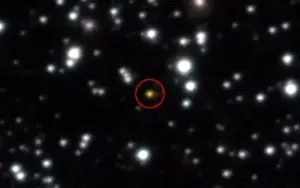
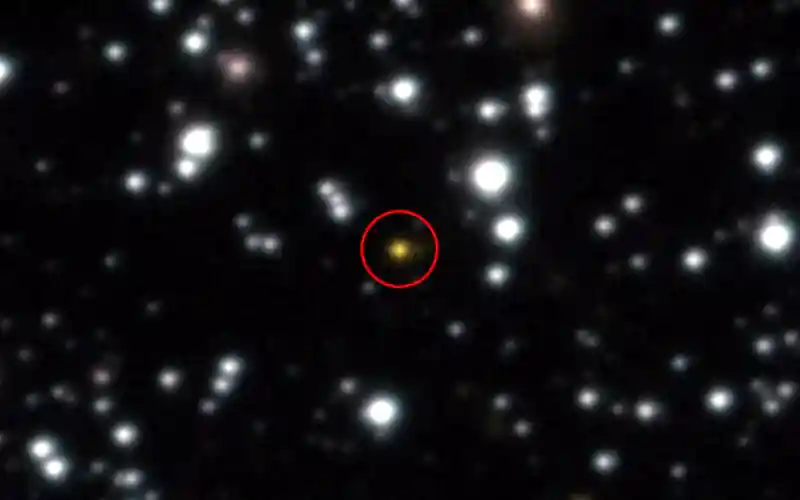
The James Webb Space Telescope has revealed numerous faint, red, compact objects in the distant universe, which astronomers have nicknamed “little red dots.” These protogalaxies are only a few hundred light‑years across, yet evidence suggests they host central black holes with masses of several million suns. Their small size combined with such massive black holes was unexpected, prompting researchers to consider whether these objects represent early galactic “seeds.” The black holes in these systems may account for a significant fraction of the galaxies’ total mass, in stark contrast to galaxies like the Milky Way, where the central black hole contributes only a tiny percentage.
This unusual mass distribution raises questions about how such black holes formed so early. Standard models struggle to explain the apparent abundance of million‑solar‑mass black holes in the young universe. Ruffini and colleagues have proposed that the direct collapse of a self‑gravitating fermion system could offer a plausible formation pathway, potentially resolving part of this puzzle. Their comparison of LRDs with the Milky Way’s center suggests that similar physical processes may govern both environments despite their vastly different scales and ages.
Another striking feature of little red dots is their lack of strong high‑energy emissions. They glow in infrared and optical wavelengths but remain dim in X‑rays, indicating that their black holes are not actively accreting large amounts of material. This subdued behavior mirrors the Milky Way’s own central black hole, Sagittarius A*, which is currently in an unusually quiet state. The similarity between these two environments is one of the key clues linking early‑universe protogalaxies to modern galactic cores.
The Milky Way’s Calm Center and Its Chemical Riches
Sagittarius A* sits at the heart of the Milky Way, yet it emits only a tiny fraction of the energy expected from a black hole of its size. Its low activity level creates a peaceful region dominated by cold gas and dust, known as the central molecular zone. This area lacks the intense outflows and radiation typical of active galactic nuclei, allowing complex molecules to accumulate and persist. Observations reveal a rich inventory of organic compounds, including nitriles, which are important precursors to RNA.
One notable example is the cloud G+0.693‑0.027, located only a few light‑years from the galactic center. This cloud is cold, dense, and free from active star formation, making it an ideal environment for fragile molecules to survive. Researchers have detected nitriles and other organics within it, reinforcing the idea that the Milky Way’s core functions as a chemical factory. These molecules may have contributed to the early solar system’s inventory of prebiotic material, potentially influencing the emergence of life on Earth.
Prebiotic Chemistry in the Early Universe
The new study argues that similar chemical processes could have occurred in little red dots more than 13 billion years ago. Their dense, dust‑rich interiors provide surfaces where atoms and simple molecules can freeze, react, and gradually form more complex organics. The absence of strong ultraviolet or X‑ray radiation further protects these molecules from destruction. Together, these conditions make LRDs plausible sites for early prebiotic chemistry on galactic scales.
This idea challenges the traditional view that complex organics require multiple generations of stars and stable environments found only in mature galaxies. Instead, the early universe may have contained numerous pockets of calm where delicate molecules could form and accumulate. As these protogalaxies merged and evolved, they would have dispersed their chemical products across space, enriching future star‑forming regions. The implications extend beyond astronomy, suggesting that the ingredients for life may have been widespread long before planets existed.
An intriguing related detail is that some scientists now suspect that early black hole activity—or the lack of it—may have played a crucial role in shaping the chemical landscape of the universe. Quiet black holes, like those in little red dots and the Milky Way, may have inadvertently created safe zones where prebiotic molecules could flourish. This perspective links black hole physics with the origins of life in a way that was rarely considered before.