
Curiosity uncovers unexpected sulfur on Mars
- NASA’s Curiosity rover uncovered pure elemental sulfur after crushing a rock in the Gediz Vallis Channel.
- The find is unusual because sulfur in this form requires conditions not previously known to exist in the region.
- Researchers are now investigating how the material formed and what it may reveal about Mars’s past.
A rare discovery beneath an ordinary rock
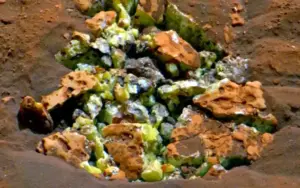
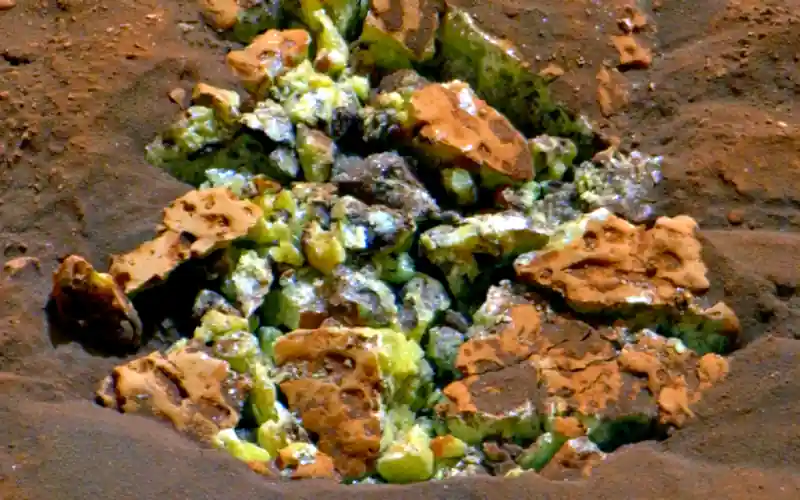
Curiosity’s latest finding began with a simple accident. The rover rolled its nearly 900‑kilogram frame over what appeared to be an unremarkable rock in May 2024, causing it to split open and expose bright yellow crystals of elemental sulfur. Although sulfates are common on Mars, sulfur in its pure form has never been observed there before. This unexpected result immediately caught the attention of mission scientists, who recognized its potential significance.
The location of the discovery adds another layer of intrigue. Gediz Vallis Channel, an ancient water‑carved region, contains numerous rocks that resemble the sulfur‑bearing specimen before it broke apart. Researchers suspect that similar deposits may be scattered throughout the area, suggesting that elemental sulfur could be more widespread than previously assumed. Such a possibility challenges current models of Martian geology, which do not predict the formation of pure sulfur in this environment.
NASA’s Ashwin Vasavada described the find as akin to stumbling upon an oasis in a desert. His comment reflects the scientific surprise rather than any dramatic interpretation, as the presence of elemental sulfur implies geological processes that remain poorly understood. The team now faces the task of determining how such material could have formed on a planet where known conditions do not easily support its creation.
What sulfur reveals about Mars
Sulfur plays a key role in planetary chemistry. On Earth, it is essential for life and is incorporated into amino acids that form proteins, though always in compound form rather than as pure sulfur. Mars has long been known to contain sulfate minerals, which form when sulfur interacts with water and other elements before evaporating. These minerals help scientists reconstruct the planet’s water history and environmental evolution.
Elemental sulfur, however, forms under much narrower conditions. Its presence in Gediz Vallis suggests that Mars may have undergone processes that scientists have not yet identified. The discovery raises questions about temperature fluctuations, volcanic activity, or chemical reactions that could have produced sulfur in this state. Each possibility would reshape current assumptions about the planet’s geological past.
Curiosity’s instruments were able to analyze the exposed crystals, confirming their composition. Without the rover’s accidental detour, the sulfur might have remained hidden for years. This highlights the unpredictable nature of planetary exploration, where chance encounters can lead to major scientific insights. The rover continues to survey the region, gathering additional data that may help clarify the origin of the sulfur.
Rovers continue to expand our understanding
While Curiosity investigates Gediz Vallis, NASA’s Perseverance rover is conducting its own exploration elsewhere on Mars. More than five years into its mission, Perseverance has been examining rocks, sediments, and atmospheric conditions to better understand the planet’s habitability. In June 2025, it set a new record by traveling 411 meters in a single drive, demonstrating its efficiency compared to earlier rovers. Its mobility allows it to reach diverse geological sites that may hold clues to Mars’s ancient environment.
One of Perseverance’s recent finds appears unusual enough that scientists are considering whether it might not be native to Mars. Such anomalies are not uncommon in planetary science, where meteorites and other foreign materials can land on a planet’s surface. Each discovery adds to the growing catalog of Martian features that researchers must interpret within a broader planetary context.
The combined efforts of Curiosity and Perseverance illustrate the value of long‑term robotic exploration. Both rovers continue to uncover evidence of water, chemical diversity, and environmental change, even if none of these findings yet point to past or present life. Their work helps refine models of Mars’s evolution and guides future missions that may one day return samples to Earth.
A landscape shaped by ancient water
Gediz Vallis Channel itself is a reminder of Mars’s dynamic past. The region was once shaped by flowing water billions of years ago, leaving behind rocks that preserve traces of ancient rivers. Curiosity’s journey through this terrain offers scientists a chance to study how water interacted with the Martian crust over long periods. Each new observation contributes to a more detailed picture of the planet’s shifting climate and surface conditions.
As Curiosity continues its slow climb through the channel, researchers expect more surprises. The rover’s path is filled with rocks of varying composition, many of which may hold clues to processes that shaped Mars long before humans studied it. The sulfur discovery underscores how much remains unknown about the planet’s geology and how much more there is to learn.
Elemental sulfur has been found in extreme environments on Earth, including volcanic regions and hydrothermal systems. These locations often involve complex chemical interactions that can produce sulfur in its pure form. If similar processes occurred on Mars, they could indicate previously unrecognized volcanic or hydrothermal activity in the Gediz Vallis region. This possibility makes the discovery particularly compelling for scientists studying Mars’s deep geological history.