
Deep‑Sea Fish Reveal Hybrid Vision Cells
- New research has uncovered a previously unknown type of visual cell in deep‑sea fish larvae, challenging long‑standing assumptions about how vertebrate vision works.
- The hybrid cells combine structural traits of rods with the molecular machinery of cones, enabling sight in dim underwater environments.
- The findings suggest vertebrate visual systems may be far more adaptable than once believed.
Hybrid Photoreceptors Challenge Textbook Biology
For more than a century, biology textbooks have described vertebrate vision as relying on two distinct photoreceptor types: rods for low‑light vision and cones for bright light and color. Scientists studying deep‑sea fish larvae in the Red Sea have now identified a third category that blends features of both. These hybrid cells resemble rods in shape but activate genes typically associated with cones. Their discovery indicates that the traditional rod‑cone division is not as rigid as previously assumed.
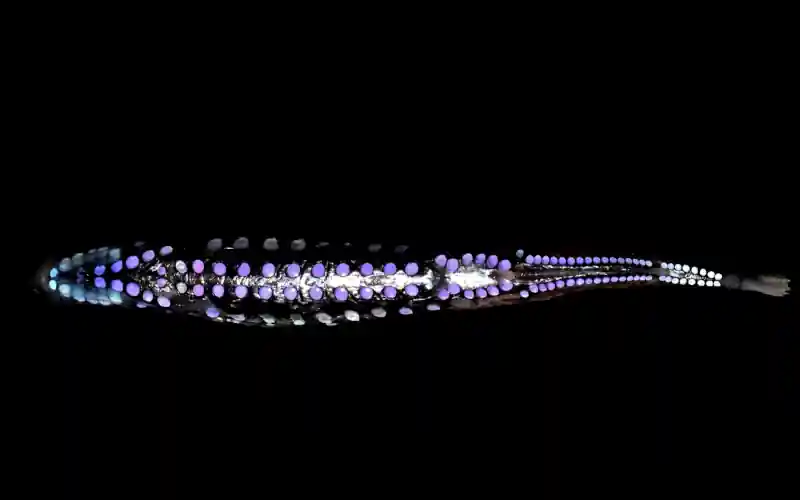
Researchers examined larvae from three species: the hatchetfish Maurolicus mucronatus, the lightfish Vinciguerria mabahiss and the lanternfish Benthosema pterotum. The hatchetfish retained the hybrid cells into adulthood, while the other two species transitioned to conventional rods and cones later in life. All three species inhabit twilight zones where sunlight barely penetrates, creating a challenging environment for vision. The hybrid cells appear to offer an evolutionary solution for detecting light in such dim conditions.
Adaptations for Life in the Twilight Zone
The vertebrate retina contains photoreceptors that detect light and convert it into neural signals, but deep‑sea environments push these systems to their limits. In dim waters, rods and cones typically operate simultaneously, yet neither performs optimally. The hybrid cells identified in these fish larvae combine rod‑like structure with cone‑like molecular function, enabling more efficient light capture. Lead author Lily Fogg of the University of Helsinki noted that the cells are optimized to gather photons while using cone‑specific genetic pathways.
The team collected larvae from depths ranging between 65 and 650 feet. Their findings show that photoreceptors can merge structural and molecular traits in unexpected ways. This flexibility suggests that vertebrate visual systems may be more evolutionarily adaptable than previously believed. Senior author Fabio Cortesi of the University of Queensland said similar cells may exist in many other vertebrates, including land‑dwelling species.
Bioluminescence and Daily Vertical Migration
All three species studied produce bioluminescent light using small organs on their bodies. They emit blue‑green light that blends with faint sunlight from above, a camouflage strategy known as counterillumination. This adaptation helps them avoid predators in the deep sea’s dim environment. The fish also play a key ecological role as prey for larger species such as tuna, marlin, dolphins, whales and seabirds.
These fish undertake one of the largest daily migrations in the animal kingdom. They rise toward the surface at night to feed on plankton and descend again during the day to avoid predators. Their movement spans depths from roughly 650 to 3,280 feet, reflecting the extreme conditions they navigate. Cortesi emphasized that the deep sea remains a largely unexplored frontier with significant potential for new discoveries.
Hybrid photoreceptors have been hinted at in a few earlier studies, but this research provides some of the clearest evidence yet that vertebrate vision is more flexible than the classic rod‑cone model suggests. The discovery may prompt scientists to revisit assumptions about how visual systems evolved across different environments. Deep‑sea species often reveal unusual biological adaptations, and their study continues to reshape understanding of sensory evolution. As exploration technologies improve, researchers expect more surprises from the ocean’s twilight zones.