
First Martian Lightning ‘Whistler’ Detected
- A rare electromagnetic signal has been identified on Mars, revealing the first confirmed whistler‑type radio emission on the planet.
- The detection suggests that lightning‑like electrical discharges occur in the Martian atmosphere despite its dry and thin conditions.
- Researchers say the finding strengthens the case that Mars hosts more Earth‑like atmospheric processes than previously proven.
A Signal Hidden in MAVEN’s Plasma Data
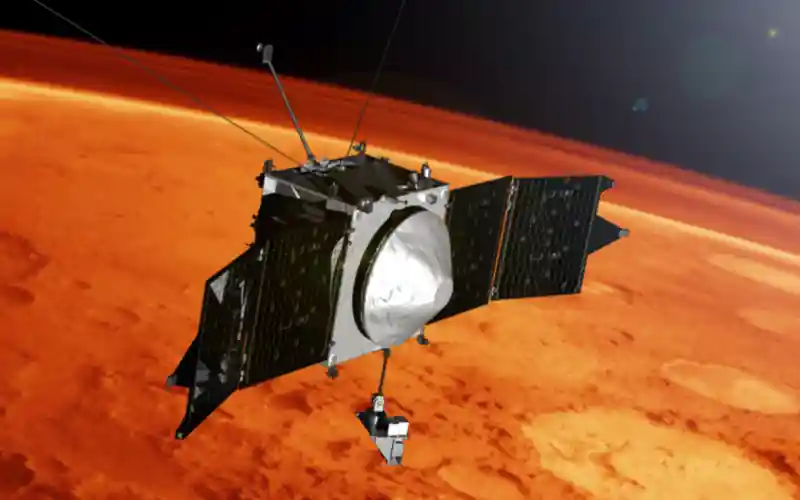
NASA’s MAVEN spacecraft captured the unusual radio signature while orbiting Mars on 21 June 2015, although its nature was only recently confirmed. Researchers analyzed more than 108,000 plasma wave recordings before identifying a single event that matched the characteristics of a whistler. The signal displayed the same frequency‑descending pattern known from terrestrial lightning emissions. Its structure indicated that the wave had traveled through the Martian ionosphere in a way consistent with long‑standing theoretical predictions.
The whistler was detected above a region containing strong crustal magnetic fields. These localized magnetic patches are remnants of Mars’ ancient global magnetic field, which disappeared billions of years ago. They can guide plasma waves in a manner similar to Earth’s magnetic field lines, enabling whistlers to propagate. MAVEN recorded the event at an altitude of 349 kilometers on the planet’s nightside, where the ionosphere is weak enough for such waves to travel.
Lightning Without Water Clouds
Lightning on Earth is typically associated with water‑rich storm clouds, yet Mars contains very little atmospheric moisture. Electrical discharges can still occur when particles collide and accumulate charge, a process that does not require water vapor. Volcanic plumes on Earth demonstrate this principle, producing intense lightning through ash‑particle friction. Martian dust storms and dust devils are believed to generate similar charging conditions.
Scientists reported evidence of electrical discharges in Martian dust activity only last year. The new whistler detection provides independent confirmation that such discharges can be powerful enough to emit detectable radio waves. Its 0.4‑second duration and downward frequency sweep closely resembled whistlers observed during volcanic eruptions on Earth. The signal was roughly ten times stronger than the surrounding background noise, making it stand out clearly in MAVEN’s data.
Implications for Martian Weather and Habitability
Modeling of the local magnetic field and plasma density showed that the signal’s properties matched what would be expected from a strong lightning discharge. Although the recorded wave was weaker than typical Earth whistlers, the original energy at the source would have been comparable to a powerful terrestrial lightning strike. The rarity of such detections is likely due to the extremely specific conditions required for propagation and observation. Only a tiny fraction of MAVEN’s measurements were taken in regions with the right magnetic geometry.
The spacecraft also needed to pass over the correct location at precisely the right moment. Mars’ ionosphere must be weak, the magnetic field nearly vertical, and the discharge strong enough to produce a detectable signal. These constraints mean that lightning may occur far more often than the data suggests. The discovery therefore opens new questions about the frequency and distribution of electrical activity on Mars.
A New Factor in the Search for Life
Electrical discharges have long been considered potential drivers of prebiotic chemistry. Laboratory experiments show that lightning can help form organic molecules essential for early life. If similar processes occur on Mars, they add another piece to the puzzle of whether the planet ever hosted conditions suitable for life’s emergence. The presence of lightning also hints at more dynamic atmospheric behavior than previously assumed.
The finding encourages further investigation into how Martian dust storms, magnetic anomalies and atmospheric structure interact. Future missions equipped with more sensitive plasma instruments could detect additional whistlers. Such observations would help determine how common lightning is on Mars and how it influences atmospheric chemistry. Understanding these processes may ultimately reshape our view of the planet’s past environment.
Researchers have noted that whistlers on Earth can travel thousands of kilometers along magnetic field lines, sometimes reaching the opposite hemisphere. If similar long‑distance propagation occurs on Mars through its crustal magnetic patches, future orbiters might detect signals originating far from their immediate location. This possibility suggests that Mars’ patchwork magnetic environment could create complex pathways for plasma waves, offering a unique natural laboratory for studying electromagnetic propagation in weakly magnetized planets.