
Giant Spinosaurus Species Discovered in Niger
Spinosaurus unearthed
- Paleontologists have discovered a new giant dinosaur species named Spinosaurus mirabilis in a remote region of the Sahara desert.
- The find challenges previous theories suggesting these predators were fully aquatic marine hunters.
- Features such as a sword-like crest and specialized teeth highlight the animal’s adaptation to inland river environments.
The Harsh Expedition to Jenguebi
Paleontologists recently announced the discovery of a new giant theropod species found within the desert regions of Niger. This specific fossil discovery represents only the second known member of the Spinosaurus genus. Researchers from the University of Chicago successfully uncovered these remains during an intensive expedition to the Sahara in 2022. The team endured harsh conditions and vast sand dunes to reach the sandstone outcrops in the Jenguebi area.
Jenguebi serves as a remote locality where ancient riverbeds once flowed through a prehistoric forested landscape. These fossils were discovered roughly 300 to 600 miles away from any ancient ocean shoreline. Such a geographical placement suggests that the animal inhabited inland environments rather than coastal regions. Information gathered from this site provides a clearer picture of how these predators distributed across the Cretaceous continent.
Driving off-road through desert terrain for almost three days was required to reach the target site. Supply convoys often became stuck in the shifting sands during the 2022 mission. Perseverance eventually led the scientists to parts of three distinct skulls and other skeletal remains. Every bone recovered helps reconstruct the biology of an animal that lived 95 million years ago.
The newly identified dinosaur has been officially named Spinosaurus mirabilis due to its striking physical features. This name translates roughly to “astonishing spine lizard,” referencing the massive sail on its back. Standing as a contemporary to Tyrannosaurus, it reached lengths of approximately 12 meters. Its estimated weight reached up to seven tons depending on the individual’s growth stage.
Specialized Anatomy and Hunting Tactics
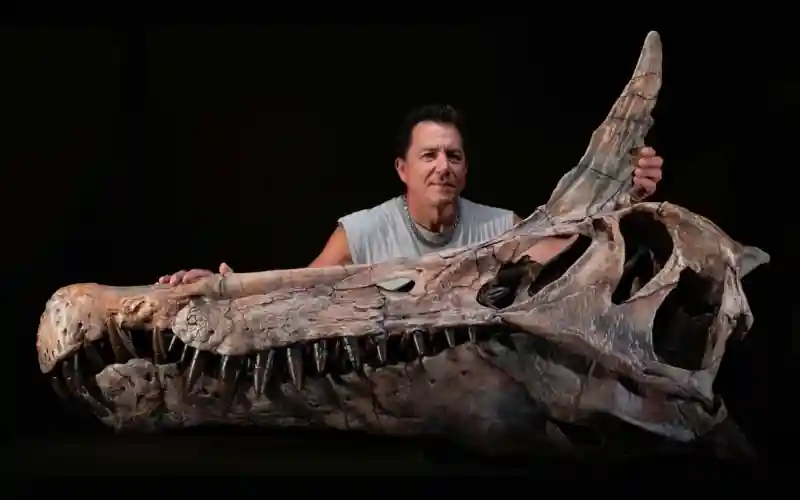
Unique anatomical traits allowed the predator to hunt effectively in freshwater systems. Its elongated snout resembles that of a modern crocodile, providing a clear advantage in aquatic environments. Nostrils positioned further back on the skull permitted the animal to breathe while submerging its mouth. This evolutionary adaptation ensured it could stalk prey for extended periods without fully surfacing.
Conical teeth without serrations played a crucial role in the dinosaur’s feeding habits. These rows of teeth fit together perfectly when the jaws closed to create a functional fish trap. Slippery prey like large coelacanths would have struggled to escape such a specialized grip. Research indicates that S. mirabilis was far more proficient at catching fish than hunting other land-dwelling dinosaurs.
A prominent sword-shaped crest distinguishes this species from its previously discovered Egyptian relative. Measuring 50 centimeters in height, this bony structure was likely sheathed in colorful keratin. Biologists believe the crest served social purposes rather than functioning as a physical weapon. Territorial displays or mate attraction probably drove the evolution of such a fragile yet visible ornament.
Comparison with Spinosaurus aegyptiacus reveals several key differences in limb and snout proportions. The Niger species possessed longer hind limbs and more widely spaced teeth. Egyptian specimens were initially described back in 1915 following an earlier wave of Saharan exploration. These variations highlight a diverse evolutionary path for large semiaquatic predators in North Africa.
Large inland waterways supported a rich ecosystem nearly 100 million years ago. Forests surrounded these rivers, providing cover for various Cretaceous period life forms. S. mirabilis likely waded into these waters like a giant heron to snare its meals. Understanding this niche helps paleontologists reconstruct the complex food webs of the African interior.
Challenging the Aquatic Hypothesis
The discovery significantly impacts the long-standing debate regarding the lifestyle of spinosaurids. Some scientists previously hypothesized that these animals were fully aquatic, deep-water swimmers. Findings in Niger’s inland rivers contradict the idea of a purely marine existence. Paul Sereno describes this evidence as a definitive blow to the fully aquatic hypothesis.
Public interest in Spinosaurus has grown significantly following its appearances in popular media. While T. rex often dominates the spotlight, these sail-backed predators offer a unique look at evolutionary experimentation. They remain the only known group of dinosaurs to adopt a semiaquatic predatory lifestyle. Ongoing research continues to refine our understanding of their peculiar biology and behavior.
Future studies will likely focus on the growth rates and locomotion of S. mirabilis. Determining how these giants moved between land and water remains a priority for the team. New technologies like CT scanning could reveal more about the internal structure of the head crest. This discovery ensures that Niger remains a critical region for future paleontological exploration.
Paul Sereno emphasized the importance of these findings for understanding prehistoric life cycles. Attracting mates and defending feeding grounds were central to the animal’s survival. The “hell heron” analogy captures the specialized role it played in the ancient river systems. This “dino-happening” marks a significant milestone in modern paleontological science.
Scientists recovered fragments from three distinct individuals to build a more complete picture. Additional skeletal elements provided the data needed to distinguish this from the Egyptian taxon. These bones were encased in hard sandstone, requiring years of preparation. Every fragment offers new insights into the biomechanics of the largest meat-eating dinosaurs.
Daniel Vidal highlighted that the creature’s adaptations were extreme compared to other predators. Its jaws were specifically evolved for piercing and trapping slippery aquatic prey. No other dinosaur displayed such a refined level of piscivorous adaptation. Such findings emphasize the diversity of specialized niches occupied by dinosaurs during the Cretaceous.
The first species of this genus, Spinosaurus aegyptiacus, has a tragic history in science. The original fossils discovered by Ernst Stromer in Egypt were housed in the Paläontologische Staatssammlung München in Germany. During World War II, a British Royal Air Force bombing raid on Munich in April 1944 destroyed the museum and its contents, including the unique Spinosaurus remains. For decades, scientists had to rely only on Stromer’s detailed drawings and descriptions until new fossils were found in the late 20th century.