
Hubble Spots Violent Collisions in Fomalhaut System
- Astronomers using NASA’s Hubble Space Telescope have observed the aftermath of two unexpected collisions in a nearby planetary system, revealing debris clouds that initially mimicked exoplanets.
- The findings overturn earlier assumptions about a mysterious bright object once thought to be a planet orbiting the star Fomalhaut.
- These observations offer rare real‑time insight into how young planetary systems evolve through destructive impacts.
A Vanishing “Planet” Reveals a Violent Origin
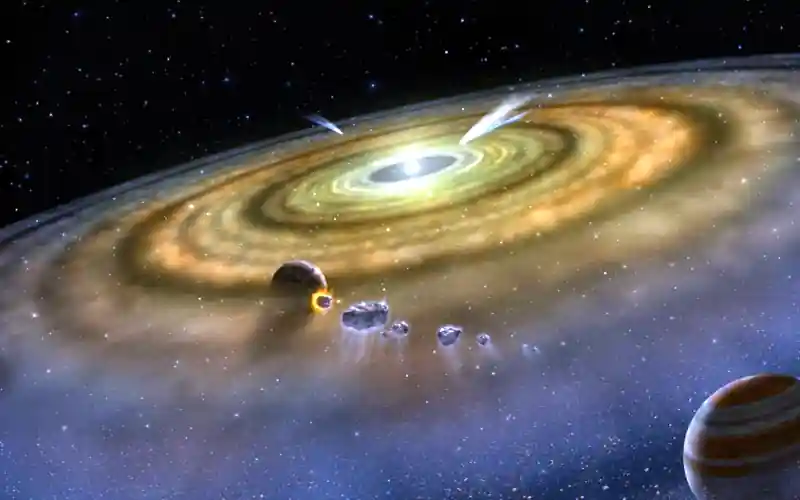
Astronomers first noticed a bright point of light near the star Fomalhaut and assumed it was a dust‑covered exoplanet reflecting starlight. That interpretation collapsed when the object disappeared and a new bright source emerged nearby. Researchers soon realized they were witnessing glowing debris clouds created by massive collisions between rocky bodies known as planetesimals. Their findings, published in Science, mark the first confirmed observation of such events outside our solar system.
Jason Wang of Northwestern University described the discovery as entirely unexpected. His team initially believed they were tracking a known object, Fomalhaut b, reported in 2008. Careful comparison with earlier Hubble images showed that the new light source could not be the same object. This prompted a reassessment of the system’s activity and the nature of the bright features.
Lead author Paul Kalas of UC Berkeley noted that the sudden appearance of a point of light in an exoplanetary system was unprecedented. The absence of the object in earlier images suggested a recent and violent collision. Such debris clouds are unlike anything currently seen in our solar system. Their presence indicates that the Fomalhaut system remains dynamically active.
The observations reveal two separate impacts that produced expanding dust clouds. Catching these events in real time provides a rare opportunity to study how planets form from smaller bodies. These collisions also offer clues about the internal structure of asteroids. Understanding such processes may inform future planetary defense strategies.
Fomalhaut’s Dusty Environment Offers Clues
The collisions occurred around Fomalhaut, a bright star located about 25 light‑years away in the constellation Piscis Austrinus. The system is known for its extensive and complex debris belts, which make it a valuable target for studying planetary formation. Astronomers have long debated the nature of a bright object called Fomalhaut b, with theories ranging from a true planet to a dust cloud. New Hubble observations in 2023 added further complexity by revealing the disappearance of the original source and the appearance of a new one.
Wang explained that the team initially intended to monitor Fomalhaut b, assuming the bright light was the same object. Detailed analysis showed that the new source did not match the earlier position or brightness profile. This realization suggested that the original object, now labeled Fomalhaut cs1, was a dispersing dust cloud. The newly detected source, Fomalhaut cs2, appears to be the result of a separate collision.
Fomalhaut cs2 resembles how cs1 appeared two decades earlier, both in brightness and location. By comparing the two events, researchers estimated that collisions in this system may occur far more frequently than theoretical models predict. Kalas noted that theory suggests one collision every 100,000 years, yet two have been observed within 20 years. This discrepancy implies that the system may be unusually active.
Because the findings were so unexpected, Wang conducted one of four independent analyses to verify the results. Each analysis detected a new transient light source in the same region. This consistency strengthened confidence in the conclusion that two separate collisions had occurred. The team emphasized the importance of verifying the data given the rarity of such events.
Implications for Planet Searches and Future Observations
The discovery highlights how dust clouds can mimic exoplanets by reflecting starlight. Such clouds may persist for years, potentially misleading astronomers searching for new worlds. Kalas noted that Fomalhaut cs2 looks almost identical to a reflective planet in early images. This serves as a caution for future missions aiming to detect Earth‑like planets using reflected light.
New observatories, including the Giant Magellan Telescope, will need to distinguish between genuine planets and temporary dust clouds. Accurate identification will be essential as astronomers attempt to image smaller and fainter worlds. The Fomalhaut findings underscore the importance of long‑term monitoring. Changes over time can reveal whether a bright source is stable or dispersing.
Researchers plan to continue observing the system, focusing next on Fomalhaut cs2. The James Webb Space Telescope (JWST) will play a key role in these efforts. Its Near‑Infrared Camera (NIRCam) can capture detailed color information that helps determine dust grain size and composition. Such data may reveal whether the debris contains water or ice.
Wang noted that Hubble’s age limits its ability to collect reliable data for this system. JWST’s advanced capabilities will allow scientists to study the collisions in greater detail. The team has already secured an approved JWST program to follow up on the event. Their goal is to better understand the parent bodies that collided and the nature of the resulting debris.
Fomalhaut has long been a subject of scientific debate because it was one of the first systems where astronomers claimed to directly image an exoplanet. That claim was later withdrawn when evidence suggested the object was actually a dispersing dust cloud. The new findings reinforce the idea that young planetary systems can produce misleading signals. This history makes Fomalhaut a valuable test case for refining future exoplanet detection techniques.