

Interstellar Visitor Passes Earth Safely
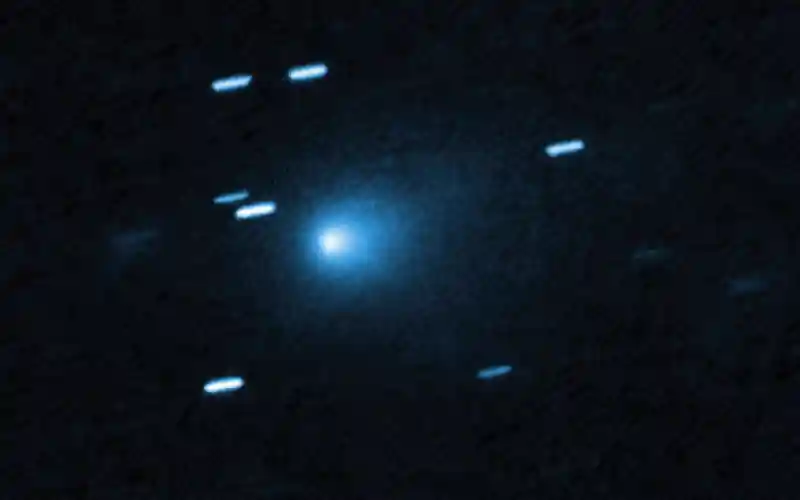
- An interstellar comet known as 3I/Atlas is making its closest pass to Earth before heading back into deep space.
- The object, discovered earlier this year, offers scientists a rare chance to study material from beyond the solar system.
- Observations continue as the comet fades, marking a brief but valuable encounter.
A Rare Interstellar Flyby
A comet originating from another star system is sweeping past Earth this week in what will be its closest approach. The object, designated 3I/Atlas, will come within 167 million miles of the planet, offering astronomers a limited window for observation. NASA has been tracking the comet with its space‑based telescopes, estimating its size to fall between 440 meters and 5.6 kilometers. Amateur astronomers may still spot it, though its brightness is diminishing as it moves outward.
The comet is expected to pass much nearer to Jupiter in March, approaching within 53 million kilometers of the gas giant. Its trajectory will carry it beyond the solar system by the mid‑2030s, after which it will not return. NASA’s Center for Near Earth Object Studies notes that this marks the comet’s final passage through the inner solar system. The encounter provides a rare opportunity to study an object shaped by conditions far different from those around our Sun.
3I/Atlas is only the third confirmed interstellar object to enter our solar system. Such comets originate in distant star systems and travel across the Milky Way before occasionally crossing paths with other planetary systems. In contrast, familiar comets like Halley’s emerge from the outer regions of our own solar neighborhood. These interstellar visitors offer scientists a unique glimpse into the composition and behavior of material formed around other stars.
Discovery and Observation Efforts
The first confirmed interstellar object was detected in 2017 by a telescope in Hawaii, marking a milestone in astronomical observation. Another was identified two years later by an amateur astronomer in Crimea, demonstrating the role of both professional and non‑professional observers in such discoveries. NASA’s Atlas telescope in Chile spotted 3I/Atlas in July while scanning the sky for potentially hazardous asteroids. Its detection added a new chapter to the growing catalog of interstellar bodies.
Researchers have been monitoring the comet closely to gather as much data as possible before it fades from view. Its diminishing brightness makes continued observation increasingly challenging, especially for smaller telescopes. Larger observatories remain focused on capturing spectral and structural information that could reveal details about its origin. These measurements help scientists compare interstellar comets with those formed within the solar system.
The comet’s harmless nature has allowed astronomers to concentrate on scientific analysis rather than impact risk. Its trajectory poses no threat to Earth or other planets. Instead, the focus remains on understanding how such objects evolve as they travel through different environments. Each observation contributes to a broader understanding of the diversity of small bodies in the galaxy.
Scientific Significance and Future Insights
Scientists believe 3I/Atlas may have originated in a star system significantly older than our own. This possibility makes it an intriguing target for research, as older systems may contain materials shaped by long‑term stellar evolution. Studying such objects can reveal clues about the chemical and physical conditions present in ancient planetary systems. These insights help build a more complete picture of how planets and comets form across the galaxy.
Interstellar comets also provide a natural comparison point for understanding the solar system’s early history. Their composition may differ from local comets, offering evidence of how environmental factors influence the development of icy bodies. Researchers hope that data collected during this flyby will support future studies of interstellar material. Continued monitoring will remain important as more such objects are discovered.
The increasing frequency of interstellar detections suggests that these visitors may be more common than once believed. Improved survey technologies and automated sky‑scanning systems are enhancing the ability to spot faint, fast‑moving objects. As detection capabilities grow, astronomers expect to identify additional interstellar comets in the coming years. Each new discovery expands the scientific community’s understanding of the galaxy’s dynamic environment.
One fascinating detail is that interstellar comets often travel at far higher velocities than solar‑system comets due to their long journeys through the Milky Way. Their speeds can exceed 50 kilometers per second, making them challenging to track but scientifically valuable. These rapid trajectories reflect gravitational interactions accumulated over millions of years. Studying their motion helps astronomers map the gravitational landscape of our galaxy.