Juno Refines Jupiter’s True Size
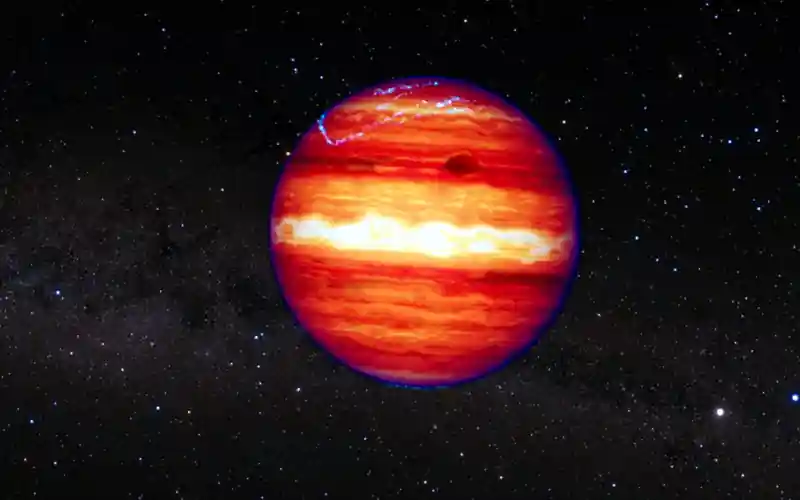
- NASA’s Juno spacecraft has provided the most precise measurements ever taken of Jupiter’s size, revealing the planet is slightly smaller than earlier estimates.
- The updated data offers new insight into Jupiter’s atmosphere and interior structure.
- These findings help refine models of how the gas giant — and the wider solar system — formed and evolved.
Juno Delivers the Most Accurate Measurements Yet
NASA scientists have used new observations from the Juno spacecraft to determine that Jupiter is marginally smaller than previously believed. The updated measurements show the planet’s equatorial diameter is 88,841 miles (142,976 km), which is about 5 miles (8 km) less than earlier estimates. Its polar diameter is now calculated at 83,067 miles (133,684 km), roughly 15 miles (24 km) smaller than past figures. These refinements highlight how even well‑studied planets can still surprise researchers.
Jupiter is not a perfect sphere, and the new data confirms it is slightly more flattened at the poles than earlier measurements suggested. The planet’s equator is about 7 percent wider than its polar diameter, a much more pronounced difference than Earth’s 0.33 percent. This shape is influenced by Jupiter’s rapid rotation and fluid composition. Understanding these details helps scientists model the planet’s internal layers more accurately.
The previous size estimates were based on data from NASA’s Voyager and Pioneer missions in the late 1970s. Juno, which has been orbiting Jupiter since 2016, offers far more precise instruments and observational opportunities. NASA extended the mission in 2021, allowing researchers to gather the additional data needed for these updated measurements. This included capturing radio signals as Juno passed behind Jupiter from Earth’s perspective.
How Juno Measured Jupiter’s Shape
The key to the new measurements lies in how Juno’s radio signal behaved when it traveled through Jupiter’s atmosphere. As the spacecraft moved behind the planet, the signal passed through layers of gas before reaching Earth. Scientists analyzed how the signal changed due to atmospheric density, temperature and composition. These variations allowed them to calculate Jupiter’s size and shape with unprecedented precision.
Planetary scientist Eli Galanti of the Weizmann Institute of Science, lead author of the study published in Nature Astronomy, explained that this alignment between Juno, Jupiter and Earth had not occurred during the spacecraft’s primary mission. The opportunity arose only after the mission extension. This unplanned configuration enabled researchers to perform experiments that were previously impossible. The result is a more detailed understanding of Jupiter’s outer layers.
Juno’s broader mission includes studying Jupiter’s atmosphere, magnetic field and deep interior. The spacecraft has already provided insights into the planet’s storms, wind patterns and magnetosphere. These new size measurements add another piece to the puzzle. Precise dimensions are essential for building accurate models of Jupiter’s internal structure.
Jupiter’s immense size makes it a key reference point for understanding gas giants both in our solar system and beyond. Its radius — half its diameter — is used in many scientific models. Refining this value helps researchers improve simulations of planetary formation and evolution. The updated measurements will influence future studies of Jupiter and similar worlds.
Why Jupiter’s Size Matters for Planetary Science
Jupiter is the largest planet in the solar system and contains most of its planetary mass. Its formation played a major role in shaping the distribution of material in the early solar system. Scientists believe Jupiter formed early and influenced the growth of other planets. Understanding its internal structure helps researchers reconstruct how the solar system evolved.
The planet is composed mainly of hydrogen and helium, with smaller amounts of other gases. Strong winds and storms dominate its colorful atmosphere. Juno’s data helps scientists determine how these atmospheric layers interact with the deeper interior. Accurate measurements of Jupiter’s radius are essential for interpreting these interactions.
Galanti notes that volatiles — substances like water, carbon dioxide and ammonia — were delivered to the inner solar system partly through processes influenced by Jupiter’s formation. These materials were crucial for shaping Earth’s atmosphere and supporting life. Studying Jupiter’s structure therefore provides indirect clues about our own planet’s history.
Earth is a small rocky world compared to Jupiter’s massive scale. More than 1,300 Earths could fit inside the gas giant. Despite this difference, the two planets share the characteristic of being slightly flattened at the poles. Juno’s findings show that Jupiter’s flattening is more pronounced, reflecting its rapid rotation and fluid composition.
Juno’s extended mission has allowed scientists to explore regions of Jupiter that were previously inaccessible. The spacecraft has flown over the planet’s poles, mapped its magnetic field and studied its faint rings. These observations continue to refine our understanding of gas giants and may inform future missions to Saturn, Uranus or exoplanets with similar characteristics.