
Jupiter’s Hidden Chemistry Comes Into Focus
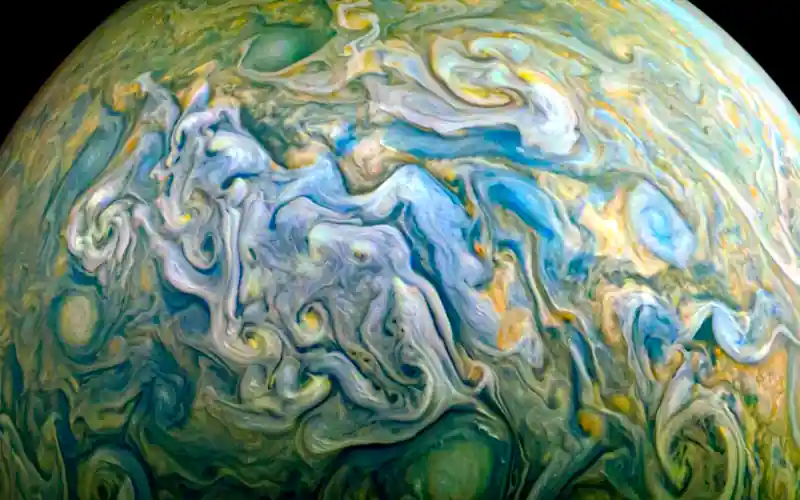
- A new atmospheric model is offering the clearest picture yet of Jupiter’s deep interior, revealing that the planet likely contains far more oxygen than the Sun.
- The research also suggests that gases circulate through Jupiter’s atmosphere much more slowly than previously believed.
- These findings reshape long‑standing assumptions about how the gas giant—and the early solar system—formed.
Peering Beneath the Planet’s Towering Clouds
Jupiter’s dramatic cloud bands and swirling storms have long obscured what lies beneath them. These dense layers, far thicker than Earth’s clouds, prevent spacecraft from directly observing the planet’s lower atmosphere. A new study led by researchers at the University of Chicago and NASA’s Jet Propulsion Laboratory has now produced the most detailed simulation of Jupiter’s atmosphere to date. Their model offers a rare glimpse into the planet’s hidden chemistry without requiring a probe to survive its crushing depths.
The work helps resolve a long‑running debate about Jupiter’s composition. Researchers estimate that the planet contains roughly one and a half times more oxygen than the Sun, a finding that carries major implications for theories of planetary formation. This result contrasts with earlier studies that suggested Jupiter might be far poorer in oxygen. The new model brings fresh clarity to a question that has challenged scientists for decades.
Lead author Jeehyun Yang emphasized how modern computational tools are transforming planetary science. She noted that the latest generation of models can capture complex interactions that older approaches could not. The study, published in The Planetary Science Journal, demonstrates how combining chemistry and physics can unlock new insights. It also highlights how much remains hidden beneath Jupiter’s turbulent exterior.
Storms, Chemistry, and the Search for Clues
Astronomers have observed Jupiter’s atmosphere for centuries, beginning with early telescope sightings of the Great Red Spot more than 360 years ago. This enormous storm, twice the size of Earth, is only one feature in a vast system of powerful winds and dense clouds. Despite their visibility, these storms reveal little about the planet’s deeper layers. NASA’s Galileo probe famously lost contact in 2003 as it descended into the atmosphere, overwhelmed by the extreme conditions.
Modern missions such as NASA’s Juno spacecraft study Jupiter from orbit, measuring chemicals in the upper atmosphere. These include ammonia, methane, ammonium hydrosulfide, water and carbon monoxide. Scientists use these observations to infer what might be happening deeper below, but past studies have often produced conflicting results. Disagreements have been especially sharp when estimating Jupiter’s water and oxygen content.
Yang and her colleagues recognized that a more sophisticated approach was needed. Jupiter’s atmosphere is a complex system where molecules shift between hot and cold regions, changing states and reacting thousands of times. Clouds and droplets form, dissolve and interact with surrounding gases. Capturing all of these processes requires a model that integrates chemistry and atmospheric motion simultaneously.
A Combined Model Reveals New Insights
The team developed a simulation that merges atmospheric chemistry with hydrodynamics, allowing them to track both chemical reactions and the movement of gases and clouds. This combined approach had not been attempted at such detail before. It enabled the researchers to follow how molecules behave as they move through different layers of the atmosphere. The result is a more complete picture of Jupiter’s internal processes.
One of the most significant findings is the revised estimate of Jupiter’s oxygen content. The model points to a value about one and a half times that of the Sun, contradicting a recent high‑profile study that suggested a much lower amount. Oxygen plays a central role in planetary formation, making this measurement crucial for understanding how Jupiter—and the early solar system—developed. Differences in elemental composition across planets offer clues about where they formed and how they migrated.
The study also addresses questions about Jupiter’s origins. Much of the planet’s oxygen is locked in water, which behaves differently depending on temperature. Farther from the Sun, water freezes into ice, making it easier for forming planets to accumulate. Understanding these conditions helps scientists reconstruct Jupiter’s early history and predict what kinds of planets might form around other stars.
A Slower and More Complex Atmosphere
The model suggests that Jupiter’s atmosphere circulates far more slowly than previously assumed. Vertical mixing of gases appears to be dramatically reduced compared to standard estimates. Yang explained that diffusion would need to be thirty‑five to forty times slower than earlier models predicted. Instead of moving through an atmospheric layer in hours, a single molecule might take weeks to travel the same distance.
This finding challenges long‑held assumptions about how Jupiter’s atmosphere behaves. Slower circulation affects how heat, chemicals and clouds move through the planet’s layers. It also raises new questions about the dynamics of gas giant atmospheres more broadly. Yang noted that the results highlight how much remains to be learned about planets—even those within our own solar system.
The study was supported by NASA and the Caltech‑Jet Propulsion Laboratory. Its findings will likely guide future research as scientists refine models of Jupiter and other gas giants. Continued observations from missions like Juno will help test these predictions and deepen our understanding of planetary atmospheres.
Jupiter’s composition has been debated since the 1970s, when early spacecraft first measured its atmospheric chemistry. Later missions revealed unexpected variations in water and ammonia levels, prompting competing theories about the planet’s formation. The new model adds weight to the idea that Jupiter formed in a colder region of the early solar system before migrating to its current orbit. This scenario aligns with emerging evidence from exoplanet studies, where many gas giants appear to have shifted positions over time.