
JWST Reveals Record‑Breaking Jellyfish Galaxy
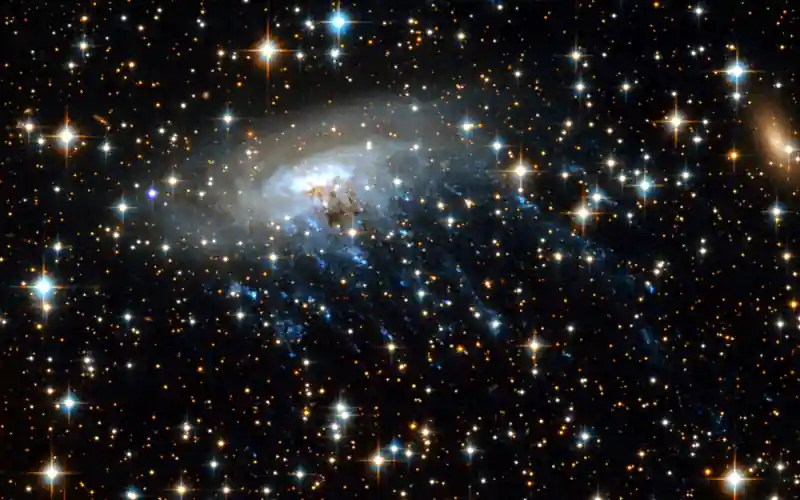
The spiral galaxy ESO 137-001, seen here in an image from Hubble, is an example of a “jellyfish” galaxy, because blue tendrils of star formation stream away from it like jellyfish tentacles. Credit: NASA, ESA
- Astronomers using the James Webb Space Telescope have identified the most distant jellyfish galaxy ever observed.
- The object appears as it was 8.5 billion years ago, offering rare insight into how galaxies evolved in the early universe.
- Its discovery suggests that galaxy clusters were far more turbulent at that time than previously believed.
A Galaxy Shaped by Extreme Cosmic Forces
Researchers at the University of Waterloo uncovered the galaxy while analyzing deep‑field JWST observations. Jellyfish galaxies are known for their long, trailing streams of gas and young stars that resemble tentacles. These structures form when a galaxy speeds through a dense cluster filled with hot gas, which pushes against it and strips material away in a process called ram‑pressure stripping. The newly identified object sits at redshift z = 1.156, meaning its light has traveled 8.5 billion years to reach Earth.
The observation provides a rare look at how galaxies were reshaped in the distant past. Many astronomers previously believed that such extreme environmental effects were uncommon in the early universe. This finding challenges that assumption by showing that cluster environments were already capable of stripping galaxies at that time. The result raises new questions about how early galaxy clusters formed and evolved.
A Clear Window Into the Distant Universe
The galaxy was found in the COSMOS field, a region frequently studied because it offers an unobstructed view of deep space. Its location avoids the dense plane of the Milky Way, reducing interference from nearby stars and dust. Telescopes in both hemispheres can observe the field, making it ideal for long‑term surveys. These conditions helped researchers identify the faint, distant jellyfish galaxy early in their JWST data search.
Dr. Ian Roberts, a Banting Postdoctoral Fellow at the Waterloo Centre for Astrophysics, said the team was specifically looking for previously unstudied jellyfish galaxies. The discovery immediately stood out due to its distinctive trailing structures. Bright blue clumps scattered along the streams indicate active star formation occurring outside the galaxy’s main disk. Their presence supports the idea that ram‑pressure stripping can trigger star formation in displaced gas.
Rethinking Galaxy Clusters in the Early Universe
The galaxy’s features suggest that cluster environments were already harsh enough to significantly alter galaxies 8.5 billion years ago. Roberts noted that this challenges earlier assumptions about when such processes became common. The findings imply that galaxy clusters may have influenced galaxy evolution earlier than expected, contributing to the large population of inactive galaxies seen in clusters today. This discovery provides a valuable data point for understanding how galaxies transition from active to quiescent states.
Further observations will be needed to confirm the galaxy’s properties and better understand its environment. Roberts and his colleagues have applied for additional JWST observing time to study the object in greater detail. Their goal is to determine how widespread such early jellyfish galaxies may have been. The study describing the discovery, JWST Reveals a Candidate Jellyfish Galaxy at z = 1.156, was published in The Astrophysical Journal.
Jellyfish galaxies were first identified in large numbers only within the past decade, thanks to improved imaging from telescopes like Hubble and now JWST. Their dramatic appearance makes them useful laboratories for studying how galaxies lose gas and shut down star formation. Ram‑pressure stripping is also observed in nearby clusters such as Virgo and Coma, but JWST’s sensitivity allows astronomers to detect the process much farther back in time. This latest discovery suggests that the mechanisms shaping galaxies today were already active when the universe was less than half its current age.