
Mapping the Invisible: Dark Matter Distribution
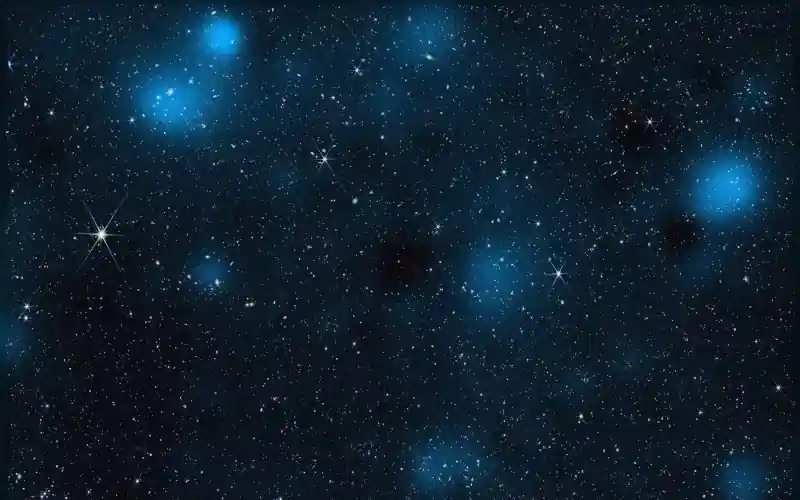
A detail of the map from NASA's James Webb Space Telescope shows dark matter in blue. Image source: NASA/STScI/J. DePasquale/A. Pagan
- Map guided by James Webb Space Telescope observations.
- Dark matter makes up 85% of matter in the universe.
- The other 15% is ordinary matter, all the visible stuff.
A New View Through Gravitational Lensing
Using the James Webb Space Telescope, researchers have charted dark matter across a region of the sky nearly three times the size of the full moon. The map was created by analyzing how light from approximately 250,000 distant galaxies is subtly distorted as it passes through massive cosmic structures. These distortions, caused by gravitational lensing, reveal the presence and distribution of matter along the line of sight. Unlike ordinary matter, dark matter does not emit or reflect light, making such indirect methods essential for its study.
Previous maps relied on data from the Hubble Space Telescope, but Webb’s enhanced capabilities allow for twice the resolution and a deeper look into the past. The new observations reach back 8 to 10 billion years, a period critical to understanding galaxy formation. This extended view enables scientists to detect smaller structures and previously unseen mass concentrations. The results were published in the journal Nature Astronomy by a team led by Diana Scognamiglio of NASA’s Jet Propulsion Laboratory.
Revealing the Cosmic Web
The map offers unprecedented detail of the cosmic web, a vast network of galaxy clusters and filaments composed primarily of dark matter. These filaments act as scaffolding for the universe, guiding the distribution of galaxies and intergalactic gas. Regions with lower mass density also appear more clearly, helping researchers understand the full range of cosmic environments. Webb’s infrared sensitivity and light-gathering power—six times greater than Hubble’s—make it uniquely suited for this kind of survey.
Scognamiglio compared Webb’s capabilities to putting on a new pair of glasses, allowing astronomers to see fainter and more distant galaxies with sharper clarity. A denser grid of background galaxies improves the accuracy of gravitational lensing measurements. More precise data translates directly into a more refined map of dark matter. The survey focused on a region known as COSMOS, located in the direction of the constellation Sextans.
Implications for Galaxy Formation
Understanding where dark matter resides and how it interacts with visible galaxies is key to modeling cosmic evolution. Dark matter halos—gravitationally bound clouds of invisible matter—serve as the birthplaces of galaxies. By linking the distribution of dark matter to the galaxies embedded within it, researchers can better constrain theories of how galaxies grow and change over time. Jacqueline McCleary of Northeastern University emphasized that this connection sets important boundary conditions for astrophysical models.
The findings align with the Lambda-CDM model, the prevailing cosmological framework that describes a universe shaped by cold dark matter and dark energy. This model begins with the Big Bang and accounts for the universe’s accelerating expansion. Within this structure, dark matter provides the gravitational backbone for the formation of galaxies, groups and clusters. The new map offers a sharper observational view of this hidden architecture, reinforcing the model’s predictions.
The COSMOS field used in this study has long been a target for multi-wavelength astronomical surveys, combining data from optical, infrared and radio telescopes. Webb’s contribution adds a new layer of depth, enabling researchers to revisit earlier findings with improved resolution. As gravitational lensing techniques advance, future maps may reveal even finer details of dark matter’s role in shaping the universe. These efforts continue to bridge the gap between theoretical models and observational evidence.