
Microsoft Launches Maia 200 AI Chip and Developer Tools
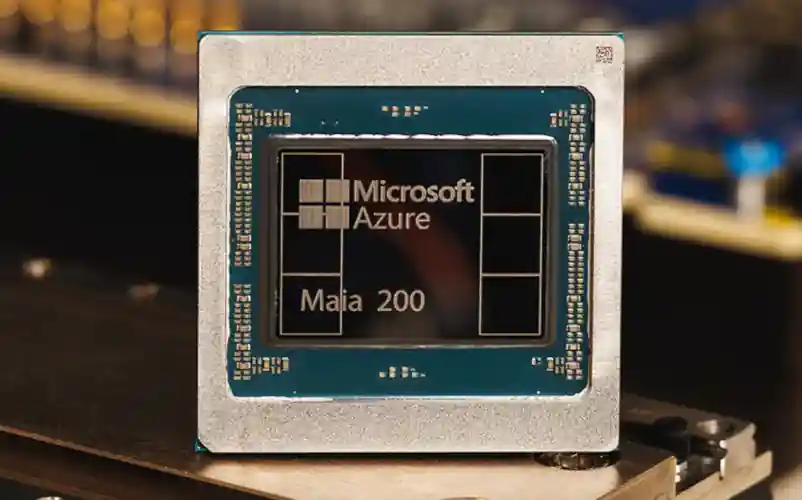
Microsoft Maia 200
- Microsoft has introduced its second-generation AI chip, Maia 200, alongside new software tools aimed at reducing reliance on Nvidia’s developer ecosystem.
- The chip is now operational in Iowa, with expansion planned in Arizona, and features architectural choices designed to optimize performance for large-scale AI workloads.
- By integrating Triton and leveraging SRAM, Microsoft is positioning itself to compete more directly with Nvidia’s hardware and software offerings.
Strategic Shift in AI Infrastructure
Microsoft has unveiled the Maia 200, its latest in-house AI chip, marking a continued push into custom silicon for cloud and enterprise applications. The chip is now active in a data center in Iowa, with a second deployment planned for Arizona. This release follows the original Maia chip introduced in 2023 and reflects growing interest among major cloud providers in reducing dependence on external suppliers. Companies like Google and Amazon are also developing proprietary chips, intensifying competition with Nvidia.
The Maia 200 arrives as Nvidia’s dominance in AI hardware faces pressure from its own customers, including Microsoft. Meta Platforms, for example, is working closely with Google to bridge software gaps between competing chip platforms. Microsoft’s strategy includes not only hardware but also a suite of programming tools designed to support developers. These tools aim to simplify adoption and reduce friction for teams transitioning away from Nvidia’s ecosystem.
Software Tools Targeting Nvidia’s Advantage
Alongside the Maia 200, Microsoft is introducing a set of software tools to help developers build and optimize AI models. Central to this package is Triton, an open-source framework with contributions from OpenAI, designed to perform tasks similar to Nvidia’s Cuda. Analysts often cite Cuda as a key factor in Nvidia’s continued lead in AI development due to its maturity and widespread adoption. By offering Triton, Microsoft hopes to provide a viable alternative that integrates smoothly with its own hardware.
The combination of custom chips and developer-friendly software reflects a broader industry trend toward vertical integration. Microsoft’s approach mirrors efforts by other firms to create unified platforms that span hardware, software and cloud services. Open-source tools like Triton also encourage community involvement and faster iteration. This strategy may help Microsoft attract developers who seek flexibility and performance without vendor lock-in.
Technical Design and Competitive Positioning
Maia 200 is manufactured by Taiwan Semiconductor Manufacturing Co using advanced 3-nanometer process technology. The chip includes high-bandwidth memory, though it uses an older generation compared to Nvidia’s upcoming Vera Rubin chips. To improve responsiveness in high-demand environments, Microsoft has incorporated a substantial amount of SRAM, a fast-access memory type. This design choice is intended to benefit applications like chatbots and real-time AI services that handle large volumes of user requests.
Other companies have adopted similar strategies, including Cerebras Systems and Groq, both of which emphasize SRAM in their architectures. Cerebras recently signed a $10 billion agreement with OpenAI to supply computing power, while Groq licensed technology to Nvidia in a deal reportedly worth $20 billion. Microsoft’s adoption of SRAM suggests a focus on latency-sensitive workloads and scalability. These features may help differentiate Maia 200 in a crowded and rapidly evolving AI hardware market.
The Triton framework used by Microsoft was originally developed to simplify GPU programming and has gained traction among researchers for its flexibility. Unlike Cuda, which is tightly coupled to Nvidia hardware, Triton is designed to be more portable across different architectures. This could make it a key asset in Microsoft’s effort to build a broader developer base for its AI chips. As competition intensifies, the success of such tools may play a critical role in shaping future adoption.