

NASA’s Maven Spacecraft Falls Silent Around Mars
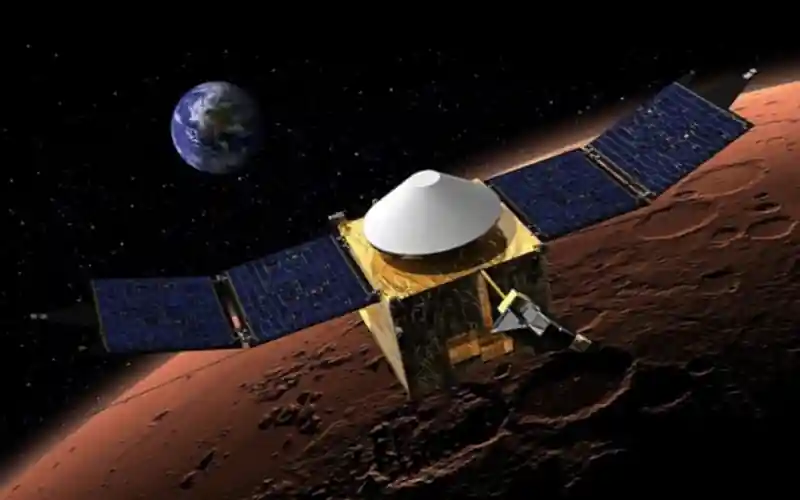
- NASA has lost contact with its Maven spacecraft, which has orbited Mars for over a decade.
- The probe stopped transmitting after passing behind the planet, raising concerns about its status.
- Engineers are investigating the issue while other orbiters continue to operate normally.
Sudden Loss of Signal
Maven ceased communication with ground stations over the weekend. NASA reported that the spacecraft was functioning properly before it moved behind Mars. When it reappeared, however, no signal was received. The agency confirmed that engineering teams are now working to determine the cause of the silence.
Launched in 2013, Maven entered Martian orbit the following year. Its primary mission was to study the planet’s upper atmosphere and the effects of solar wind. Findings from the probe helped explain how Mars lost most of its atmosphere over billions of years. Scientists concluded that solar activity stripped the planet of its once warm and wet environment, leaving it cold and dry today.
Role in Mars Exploration
Beyond its scientific mission, Maven has served as a communications relay. The spacecraft supported data transmissions for NASA’s rovers Curiosity and Perseverance. This role made it a vital part of ongoing exploration efforts on the Martian surface. Losing contact with Maven could complicate relay operations, though other orbiters remain available.
NASA still operates two long-serving spacecraft around Mars. The Mars Reconnaissance Orbiter, launched in 2005, continues to provide high-resolution imaging and data. Mars Odyssey, in orbit since 2001, remains functional as well. Together, these missions ensure that communication and observation of the planet are not interrupted.
Maven’s scientific contributions include detecting auroras on Mars, which occur when solar particles interact with the atmosphere. These auroras differ from Earth’s, as they can appear across the entire planet rather than near the poles. The discovery offered new insights into Martian atmospheric dynamics. If contact is restored, Maven could continue to expand knowledge of how solar activity shapes planetary environments.