
New Images Transform Understanding of Stellar Novae
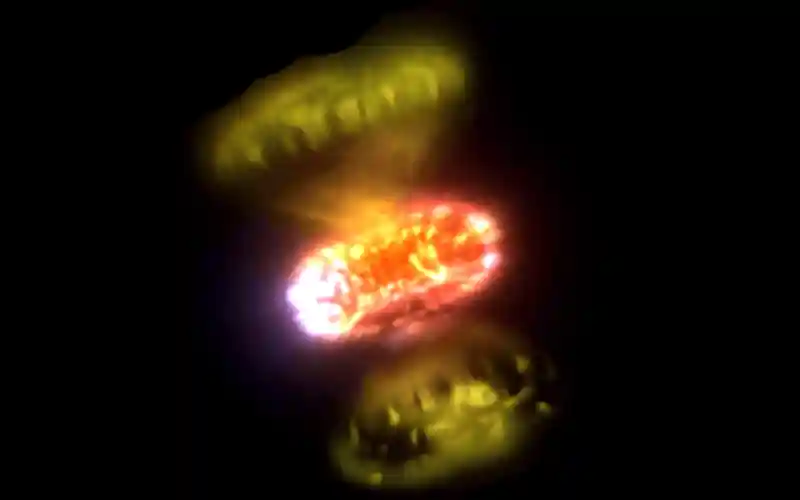
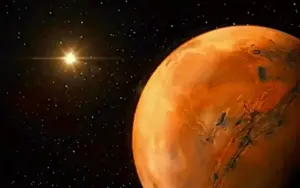
Artistic impression of Nova V1674 Herculis. Credit: The CHARA Array
- Astronomers have captured the most detailed images to date of two stellar explosions, revealing that novae unfold through complex, multi‑stage processes rather than single, simple blasts.
- The observations show multiple streams of ejected material and delayed outflows that reshape long‑held assumptions about how these eruptions behave.
- These findings mark a significant step forward in understanding shock formation, gamma‑ray production and the broader physics of stellar explosions.
High‑Resolution Imaging Reveals Unexpected Complexity
New interferometric images from the CHARA Array in California have provided an unprecedented look at two novae just days after their eruptions began. Earlier studies could only observe these events as unresolved points of light, leaving astronomers to infer the earliest stages indirectly. The new data show that novae can eject material in several directions and may delay parts of the outburst, creating a far more dynamic process than previously recognized. Researchers published their results in Nature Astronomy, highlighting how the added resolution allowed them to track rapid structural changes in real time.
The team combined light from multiple telescopes to achieve extremely sharp views of the expanding debris. This approach enabled scientists to directly observe how material moved away from the white dwarf during the explosion. Georgia State University’s Gail Schaefer noted that capturing such transient events requires flexible scheduling as new targets emerge unexpectedly. The ability to image these early phases offers insights that were previously out of reach.
Interferometry played a central role in revealing the fine structure of the ejecta. The technique, also used in efforts to image the Milky Way’s central black hole, allowed astronomers to resolve features only a few days after the eruptions began. These observations provide a rare opportunity to watch the unfolding of a stellar explosion with exceptional clarity. The results demonstrate how rapidly evolving these systems can be.
Spectroscopic data from facilities such as Gemini complemented the images. Changing spectral signatures matched structures seen in the interferometric observations, confirming how different gas flows formed and collided. This one‑to‑one correspondence strengthens the interpretation of the visual data. Together, the two methods offer a more complete picture of nova behavior than either could provide alone.
Two Novae, Two Very Different Explosive Paths
The study focused on two novae that erupted in 2021, each showing distinct characteristics. Nova V1674 Herculis evolved extremely quickly, brightening and fading within days. Images revealed two perpendicular gas flows, indicating multiple ejections interacting with one another. The timing aligned with gamma‑ray detections from NASA’s Fermi telescope, directly linking the observed shocks to high‑energy radiation.
Nova V1405 Cassiopeiae followed a much slower trajectory. It retained its outer layers for more than 50 days before releasing them, offering the clearest evidence yet of delayed expulsion in a nova. When the material finally escaped, it triggered new shocks that again produced gamma rays detected by Fermi. These contrasting behaviors show that novae can unfold in dramatically different ways.
Lead author Elias Aydi described the observations as a shift from “grainy black‑and‑white” understanding to something closer to high‑definition video. The ability to watch these explosions evolve in real time marks a major advance in stellar astrophysics. Such detailed monitoring was long considered nearly impossible due to the speed and unpredictability of nova eruptions. The new data challenge long‑standing assumptions about how these events progress.
The findings also help explain why novae generate strong shocks capable of producing gamma rays. Earlier work from Fermi‑LAT had shown that novae emit high‑energy light, but the mechanisms behind it were not fully understood. The new images reveal how colliding outflows create the conditions needed for particle acceleration. This connection positions novae as valuable laboratories for studying extreme physics.
Implications for Shock Physics and Stellar Evolution
The results reshape the traditional view of novae as single, impulsive explosions. Instead, the observations point to multi‑stage processes involving several outflows and, in some cases, delayed release of the star’s outer layers. These dynamics influence how shock waves form and how energy is distributed throughout the system. Understanding these mechanisms is essential for interpreting gamma‑ray signals and other high‑energy emissions.
Researchers emphasize that novae offer a unique opportunity to study shock physics in real time. Their relatively frequent occurrence and rapid evolution make them accessible targets for multi‑wavelength observations. NASA’s Fermi telescope has played a key role in identifying gamma‑ray‑producing novae, revealing more than 20 such events in its first 15 years. The new imaging results help clarify how these emissions arise.
The study also highlights the importance of coordinated observations across different instruments. Interferometry provides spatial detail, while spectroscopy reveals the physical conditions within the ejecta. Together, these tools allow scientists to trace how material moves, interacts and accelerates. This combined approach is likely to become increasingly important as more novae are observed at high resolution.
Researchers believe these findings represent only the beginning of a deeper exploration into nova physics. Future observations may uncover additional variations in how these explosions unfold. The team plans to continue monitoring new events as they occur, taking advantage of the CHARA Array’s capabilities. Their work is supported by the National Science Foundation and institutional partners at Georgia State University.
Novae were once considered relatively minor stellar events compared to supernovae, but recent discoveries have elevated their scientific importance. Some models suggest that repeated nova eruptions may contribute to the chemical enrichment of galaxies by distributing elements such as nitrogen and carbon into interstellar space. This process could influence star formation and the long‑term evolution of galactic environments. As imaging techniques improve, researchers expect to refine these models and better understand novae’s role in cosmic ecosystems.