
Organic Origins of Jupiter’s Moons
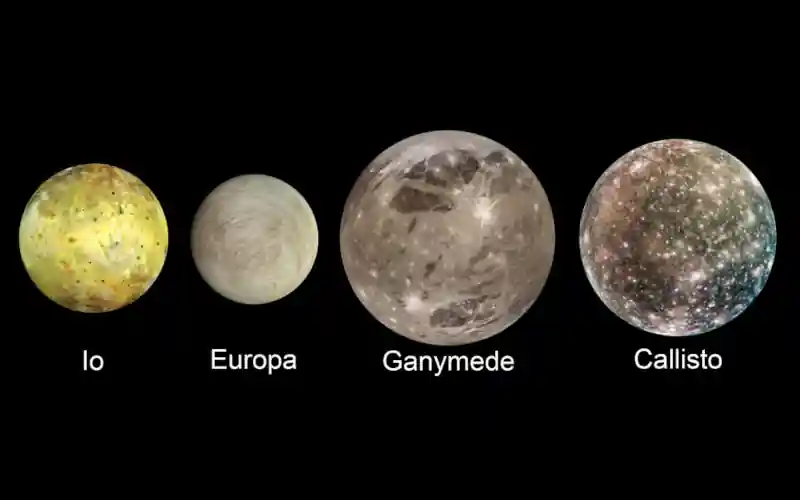
- New research suggests that Jupiter’s Galilean moons may have incorporated complex organic molecules during their formation.
- The findings come from two complementary studies that model how early icy grains could have carried life‑related chemistry into the Jovian system.
- These results offer fresh insight into the potential habitability of Europa, Ganymede and Callisto.
How Early Organics Could Form in Space
Complex organic molecules, or COMs, are essential precursors to life and can form under specific conditions in protoplanetary environments. Laboratory experiments have shown that methanol‑rich or carbon‑dioxide‑and‑ammonia‑based ices can produce COMs when exposed to ultraviolet radiation or moderate heating. These processes occur naturally in the disks of gas and dust surrounding young stars. Researchers used this knowledge to explore how similar chemistry might have unfolded in the early solar system.
Dr. Olivier Mousis of the Southwest Research Institute explained that the team combined disk‑evolution models with particle‑transport simulations to determine the environments icy grains experienced. Their work allowed them to compare astrophysical conditions with laboratory results that generate COMs. The analysis showed that both the protosolar nebula and Jupiter’s circumplanetary disk could support the formation of these molecules. This dual pathway suggests multiple opportunities for organics to arise before the moons formed.
Modeling the Birth of the Galilean Moons
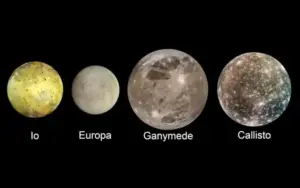
The international research team included scientists from the United States, France and Ireland. They developed detailed models of the protosolar nebula, which produced the Sun and planets, and Jupiter’s circumplanetary disk, which shaped the gas giant’s moons. By integrating a grain‑transport module, the researchers tracked how icy particles moved through these environments. This approach enabled them to reconstruct the chemical histories of the materials that eventually built Europa, Ganymede, Callisto and Io.
Their simulations showed that a significant fraction of icy grains could have acquired COMs before reaching the region where the moons accreted. In some scenarios, nearly half of the modeled particles transported newly formed organics from the protosolar nebula into Jupiter’s disk without major alteration. The studies also indicate that COMs could have formed locally within Jupiter’s orbit under suitable thermal conditions. These findings imply that the moons inherited organic material from both large‑scale solar processes and local disk chemistry.
Implications for Habitability and Future Missions
Europa, Ganymede and Callisto are believed to host subsurface oceans beneath their icy crusts. The early incorporation of COMs suggests that these moons may contain not only water and internal energy sources but also the chemical ingredients needed for prebiotic reactions. Such conditions could support the formation of amino acids, nucleotides and other building blocks of life. The research therefore strengthens the case for exploring the Jovian system as a potential habitat.
Mousis noted that the moons likely did not form as chemically pristine worlds. Instead, they may have accumulated a substantial inventory of organic molecules during their earliest stages. NASA’s Europa Clipper and the European Space Agency’s Juice missions are currently en route to study the moons’ composition and structure. Their measurements could help confirm whether COMs are present on or beneath the surfaces of these icy worlds.
The idea that organic molecules can form in cold, radiation‑rich environments has gained traction in recent years. Similar processes have been observed in laboratory simulations of interstellar ices, and COMs have been detected in star‑forming regions across the galaxy. These findings suggest that the chemistry leading toward life may be more common in planetary systems than once believed. If Jupiter’s moons indeed inherited such material at birth, they may offer a valuable window into how life‑related chemistry begins on young worlds.