
Rethinking Einstein–Rosen Bridges and Time
- New research suggests that Einstein and Rosen’s original idea, long misinterpreted as the basis for wormholes, may instead reveal a deeper structure of time in the universe.
- The study argues that the Einstein–Rosen bridge represents a connection between two microscopic arrows of time rather than a spatial tunnel.
- This reinterpretation could offer a path toward reconciling quantum mechanics with general relativity.
A Bridge Misunderstood for Decades
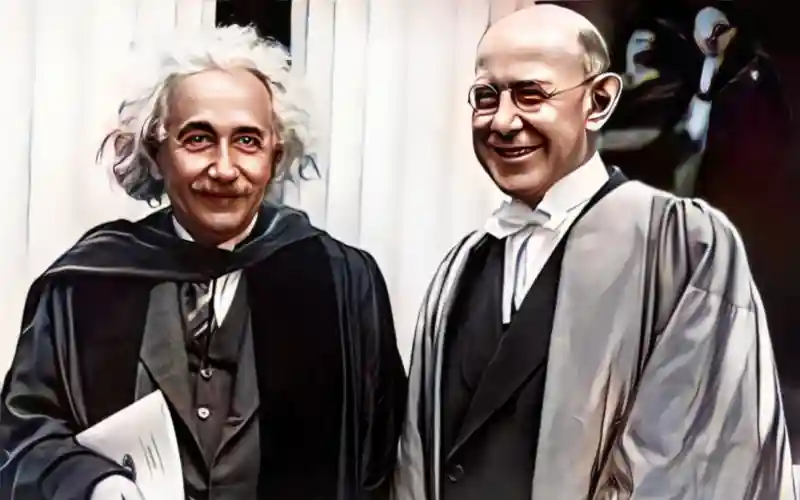
Wormholes are often depicted as shortcuts through space or time, yet this popular image stems from a misunderstanding of early theoretical work. Einstein and Rosen (pictured) introduced their “bridge” in 1935 while studying how particles behave in regions of intense gravitational curvature. Their construction linked two symmetrical copies of spacetime and was never intended as a traversable passage. Only later did the concept become associated with wormholes, despite having little connection to the original purpose.
New research published in Classical and Quantum Gravity revisits the original idea and argues that it points to something more fundamental than a hypothetical tunnel. The puzzle Einstein and Rosen explored concerned the behavior of quantum fields in curved spacetime rather than interstellar travel. Interpreted through this lens, the bridge acts as a mirror-like structure linking two microscopic time directions. This perspective reframes the bridge as a temporal relationship rather than a spatial shortcut.
Quantum mechanics governs the smallest scales of nature, while general relativity describes gravity and the structure of spacetime. Reconciling these two frameworks remains one of the central challenges in physics. The reinterpretation proposed by the researchers suggests that the Einstein–Rosen bridge may help bridge this conceptual divide. Their work highlights how time symmetry plays a crucial role in understanding the underlying physics.
The “wormhole” interpretation emerged decades after Einstein and Rosen’s publication. Physicists in the late 1980s speculated about crossing from one side of spacetime to another, giving rise to the modern wormhole metaphor. Those same analyses, however, showed that such travel is forbidden within general relativity because the bridge collapses too quickly. Einstein–Rosen bridges are therefore unstable mathematical structures rather than physical portals.
Two Complementary Arrows of Time
The new interpretation builds on modern quantum ideas developed by Sravan Kumar and João Marto. Most fundamental physical laws do not distinguish between past and future, and they remain valid even when time or space is reversed. Taking these symmetries seriously leads to a different understanding of the Einstein–Rosen bridge. Instead of a tunnel, it becomes two complementary components of a single quantum state.
In one component, time flows forward, while in the other it flows backward from a mirror-reflected position. This symmetry is not philosophical but required for quantum evolution to remain complete and reversible once infinities are removed. The bridge expresses the need for both time directions to describe a full physical system. In everyday situations, physicists choose one arrow of time and ignore the reversed component.
Near black holes or in expanding and collapsing universes, both time directions must be included for a consistent quantum description. It is in these extreme environments that Einstein–Rosen bridges naturally appear. At the microscopic level, the bridge allows information to pass across what appears to be an event horizon. Information does not vanish but continues evolving along the opposite temporal direction.
This framework offers a potential resolution to the black hole information paradox. Hawking radiation suggests that black holes can evaporate, seemingly erasing information about what fell into them. The paradox arises only if horizons are described using a single arrow of time extended to infinity. If both time directions are included, information is preserved without requiring exotic new physics.
A Universe That May Bounce Instead of Begin
These ideas are challenging because humans experience only one direction of time. Entropy increases on macroscopic scales, giving rise to the familiar arrow of time. Quantum mechanics, however, allows more subtle behavior that does not always align with everyday intuition. Evidence for this hidden structure may already exist in the cosmic microwave background.
The afterglow of the Big Bang shows a small but persistent asymmetry: a preference for one spatial orientation over its mirror image. This anomaly has puzzled cosmologists for two decades because standard models assign it extremely low probability. Including mirror quantum components makes the asymmetry more natural. The new interpretation therefore connects theoretical ideas with observational hints.
The picture also aligns with a deeper possibility: the Big Bang may not have been the absolute beginning. Instead, it could represent a bounce between two time-reversed phases of cosmic evolution. In this scenario, black holes might act as bridges not only between time directions but between different cosmological epochs.
Our universe could be the interior of a black hole formed in a parent cosmos. A collapsing region of spacetime might have bounced and begun expanding as the universe we observe today. Relics from the pre-bounce phase, such as small black holes, could survive and reappear in our expanding universe. Some of the unseen matter attributed to dark matter might consist of such relics.
In this view, the Big Bang becomes a gateway rather than a beginning. Wormholes are unnecessary because the bridge is temporal, not spatial. The reinterpretation offers no shortcuts across galaxies or science-fiction time travel. Instead, it provides a consistent quantum picture of gravity in which spacetime balances opposite directions of time.
Research into time symmetry has gained momentum in recent years, partly due to advances in quantum gravity models. Several independent groups have explored “time-reversal duality” as a potential feature of the early universe. These efforts suggest that the idea of a bouncing cosmos is becoming increasingly prominent in theoretical physics, even though direct observational tests remain challenging.