
Salt feedback may have deepened Snowball Earth
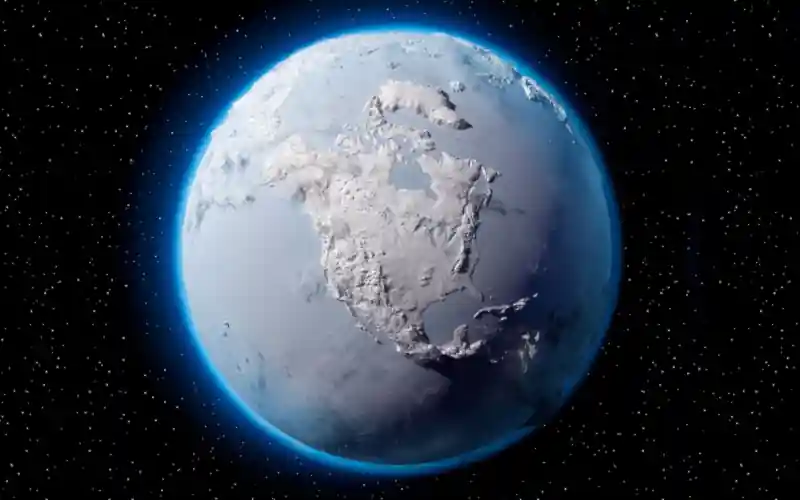
- New research suggests that salt left behind on ancient sea ice may have intensified Earth’s global glaciation more than 700 million years ago.
- The study argues that salt‑driven albedo changes could have strengthened cooling during the early stages of Snowball Earth.
- Its findings indicate that this overlooked process might have made the frozen climate harder to reverse.
A New Look at an Ancient Global Freeze
Earth entered one of its most extreme climate states between roughly 720 and 635 million years ago, when ice sheets expanded from the poles to the tropics. Geological evidence from low‑latitude rock formations shows clear signs of glacial activity, indicating that the planet’s surface was almost entirely encased in ice. Researchers have long attributed this dramatic shift to the ice‑albedo feedback, where expanding ice reflects more sunlight and reinforces cooling. A new study published in Climate of the Past now proposes that salt expelled from sea ice may have added another layer to this feedback loop.
The idea centers on how sea ice forms and evolves under very cold conditions. Modern polar ice does not freeze as pure water; instead, salt is pushed out of the forming ice lattice, leaving brine pockets that can later crystallize. Under Snowball Earth conditions, vast areas of exposed sea ice would have undergone intense sublimation, leaving behind bright salt residues. These salt crystals could have increased the planet’s reflectivity even further, amplifying the cooling already driven by expanding ice.
Researchers from UiT—The Arctic University of Norway developed a simplified climate model to explore how this salt‑albedo feedback might have operated. Their simulations show that once salt began accumulating on the ice surface, it strengthened the cooling trend already underway. The process acted like an accelerator, pushing the planet more rapidly toward a fully frozen state. The model also suggests that reversing this deep freeze would have required significantly more warming than scenarios without the salt effect.
This finding adds nuance to the long‑standing view that ice‑albedo feedback alone drove Snowball Earth. Salt precipitation may have played a supporting but meaningful role in locking the planet into its frozen condition. The researchers emphasize that this mechanism would have been most influential during the early stages of glaciation, when exposed sea ice was widespread. Their work highlights how small‑scale physical processes can have outsized impacts on planetary climate.
How Salt Alters Climate Dynamics
Salt influences climate in several ways, particularly through its effects on ocean salinity and circulation. Differences in salinity affect water density, which in turn shapes how heat moves through the oceans. Previous studies have shown that salinity variations can change how easily a planet enters or exits a Snowball state. The new research builds on this by examining how salt left on the ice surface could have altered the planet’s reflectivity.
Laboratory and field measurements indicate that salty ice can have a very high albedo, sometimes exceeding that of ordinary snow. Despite this, most global climate models used to study Earth’s deep past have not incorporated salt‑driven albedo changes. As a result, many simulations may have underestimated how reflective Earth’s surface became once sea ice began shedding salt. The new study suggests that this omission could help explain why Snowball Earth was so severe and long‑lasting.
The researchers caution that their model is intentionally simple and does not include many real‑world processes. Clouds, wind patterns and ice dynamics all influence how salt accumulates and persists on ice surfaces. It remains uncertain whether large, stable salt crusts would have formed across Snowball Earth’s frozen oceans. More complex models will be needed to test how robust the salt‑albedo feedback might have been under realistic conditions.
Even with these uncertainties, the study underscores the importance of considering overlooked physical processes in climate modeling. Small changes in surface reflectivity can have major consequences when applied across an entire planet. The salt‑albedo feedback may not replace the classic ice‑albedo mechanism, but it adds another piece to the puzzle of how Earth entered such an extreme climate state. Understanding these interactions helps refine our picture of ancient climate behavior.
Broader Implications for Planetary Climate
Snowball Earth events were not isolated anomalies but part of a series of dramatic climate swings during the Neoproterozoic era. These fluctuations may have influenced the evolution of early life by reshaping environmental conditions. Studying the mechanics of global glaciation helps scientists understand how planetary climates respond to strong feedbacks and external forcing. The salt‑albedo hypothesis contributes to this effort by highlighting a process that could operate on other icy worlds as well.
Planetary scientists often look to Earth’s deep past to understand how exoplanets might behave under extreme conditions. A mechanism that increases surface reflectivity through salt deposition could be relevant for planets with saline oceans and cold climates. This adds another dimension to the search for habitable environments beyond Earth. The new findings therefore have implications that extend beyond geology and into planetary science.
The study also illustrates how climate systems can become resistant to change once certain thresholds are crossed. If salt‑driven albedo significantly increased reflectivity, it may have made Snowball Earth more stable and harder to escape. This aligns with other research showing that global glaciations can create strong hysteresis effects, where returning to a warmer climate requires much greater forcing than entering the frozen state. Such insights help scientists understand the resilience and fragility of climate systems.
As models grow more sophisticated, researchers may uncover additional processes that shaped Earth’s ancient climate. The salt‑albedo feedback is one example of how seemingly minor physical details can influence global outcomes. Future work will likely explore how this mechanism interacted with volcanic activity, atmospheric composition and ocean circulation. Each new piece of evidence brings us closer to understanding one of the most dramatic climate transitions in Earth’s history.
A lesser‑known fact is that Snowball Earth conditions may have helped trigger the rise of complex life. Some researchers propose that the extreme glaciations increased nutrient availability in the oceans once the ice melted, potentially fueling biological innovation. This connection remains debated, but it highlights how catastrophic climate events can sometimes set the stage for major evolutionary shifts.