

Top Software Solutions of 2025 Highlight User‑Driven Excellence
- Info‑Tech Research Group has released its annual list of the top‑rated software solutions, based entirely on verified end‑user feedback collected through its SoftwareReviews platform.
- The rankings reflect real‑world performance across usability, reliability and business value.
- This year’s results span a wide range of technology categories and emphasize the importance of consistent user satisfaction in software evaluation.
How the Top‑Rated Solutions Were Identified
Info‑Tech Research Group announced the top‑rated software solutions of 2025, drawing on extensive end‑user feedback gathered through its SoftwareReviews platform. The evaluation process covered hundreds of software categories and incorporated up to 130 data points per product. These inputs were aggregated into a Composite Score that reflects user satisfaction with features, capabilities, customer experience and likelihood to recommend. The methodology is designed to ensure that rankings are based solely on genuine user experiences rather than analyst or vendor influence.
The results highlight software that consistently performs well in real‑world environments. High scores across usability, reliability and business value indicate that these tools help organizations operate efficiently, especially when time and resources are limited. Positive user sentiment also plays a key role in shaping purchasing decisions, as customers often rely on peer recommendations. Info‑Tech emphasizes that this approach provides a detailed and accurate view of a rapidly evolving software market.
The 2025 list spans core technology areas such as IT security, ERP, marketing, HR, data management and business intelligence. These categories represent essential components of modern organizational infrastructure. By focusing on user‑validated performance, the rankings aim to guide buyers toward solutions that deliver consistent value. The findings also offer vendors insight into how their products are perceived by customers.
The Ten Highest‑Rated Software Solutions of 2025
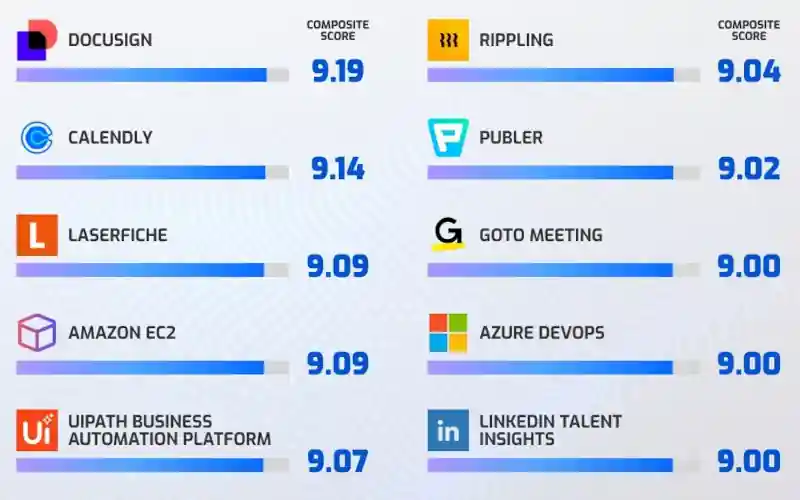
The top‑rated software solutions of 2025 earned their positions by maintaining high scores across all key evaluation criteria. DocuSign led the list with a Composite Score of 9.19, recognized for enabling secure digital approvals and e‑signatures. Calendly followed closely with a score of 9.14, supporting efficient scheduling across teams. Laserfiche and Amazon EC2 both scored 9.09, reflecting strong performance in enterprise content management and cloud computing respectively.
UiPath’s Business Automation Platform achieved a score of 9.07, highlighting its role in turning AI capabilities into operational improvements. Rippling Spend earned a 9.04 for its visibility and automated controls across organizational spending. Publer, with a score of 9.02, was recognized for helping teams manage and measure social media content. GoTo Meeting, Azure DevOps and LinkedIn Talent Insights each received a score of 9.00, demonstrating consistent reliability in online meetings, software development workflows and workforce analytics.
Info‑Tech analysts note that being top‑rated requires more than excelling in a single area. Solutions must demonstrate balanced performance across usability, reliability and business value. Consistent user feedback is a strong indicator of how well a product meets expectations in diverse environments. These results help organizations identify tools that are likely to perform reliably under real‑world conditions.
The rankings also reflect broader trends in software adoption. Tools that streamline workflows, support remote collaboration or enhance automation continue to receive strong user support. As organizations navigate increasingly complex digital ecosystems, dependable software becomes essential for maintaining productivity. The 2025 list highlights products that have earned user trust through sustained performance.
Why User‑Driven Evaluation Matters
SoftwareReviews’ user‑driven methodology provides a detailed perspective on how products perform throughout their lifecycle. Feedback comes from IT professionals and end‑users who interact with the software during procurement, implementation and ongoing maintenance. This approach captures both technical and experiential factors that influence long‑term satisfaction. Info‑Tech’s reports therefore offer a grounded view of market dynamics.
Emily Wright, Senior Research Analyst at Info‑Tech, emphasized that top‑rated solutions deliver value across multiple dimensions. She noted that usability, reliability and business impact all contribute to strong Composite Scores. These attributes help organizations operate with fewer disruptions and greater confidence. Her comments underscore the importance of evaluating software holistically rather than focusing on isolated features.
The SoftwareReviews platform also supports vendors by providing insights into customer needs and expectations. Peer‑driven resources and advisory services help companies refine product strategies and communicate value more effectively. This feedback loop benefits both buyers and providers by promoting transparency and continuous improvement. Info‑Tech positions the platform as a tool for informed decision‑making in a crowded software landscape.
Info‑Tech Research Group continues to expand its advisory services across IT, HR and marketing. Its SoftwareReviews platform remains a central resource for organizations seeking data‑driven guidance on software selection. Media professionals can access the firm’s research through the Media Insiders program, which offers unrestricted entry to reports and analyst insights. Additional information is available through Info‑Tech’s website and social channels.
Composite scoring systems like SoftwareReviews’ have become increasingly influential as organizations prioritize user experience in software procurement. Studies show that peer recommendations often outweigh traditional analyst reports when buyers evaluate new tools. This shift reflects a broader trend toward evidence‑based decision‑making grounded in real‑world performance rather than vendor claims.