

Topological Antenna Design Points Toward Future 6G Networks
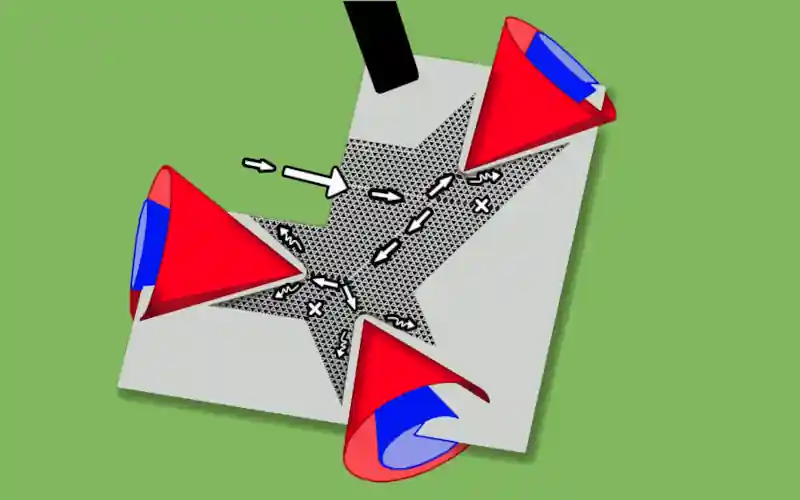
- Researchers have developed a compact terahertz antenna inspired by topological photonics, offering a promising route toward future 6G wireless systems.
- The design enables wide‑angle transmission and reception using a passive chip‑based structure.
- Early demonstrations show data rates far beyond current terahertz devices, suggesting a potential foundation for fully integrated 6G hardware.
Why Terahertz Antennas Matter for 6G
Future 6G networks are expected to deliver data rates approaching one terabit per second, a level far beyond the capabilities of today’s 5G systems. Achieving such speeds requires wireless communication at terahertz frequencies, where signals can carry far more information. Existing antenna technologies struggle at these frequencies because they often rely on large arrays or mechanically steered components. These approaches increase cost and complexity, making them difficult to scale for widespread deployment.
Researchers argue that a fundamental redesign of terahertz antennas is needed to make 6G practical. Traditional methods that worked for earlier generations cannot easily be adapted to the challenges of terahertz operation. High‑frequency signals are more sensitive to scattering, interference and physical imperfections. Without new techniques, the performance gains promised by 6G may remain out of reach.
A team led by Ranjan Singh at the University of Notre Dame has proposed a solution based on concepts from topological photonics. Their work, published in Nature Photonics, demonstrates how carefully engineered materials can guide electromagnetic waves along protected paths. This approach allows antennas to operate efficiently without relying on moving parts or complex steering mechanisms.
Topological Photonics Enables a New Antenna Design
Topological photonics studies how patterned materials can force light to travel along robust, defect‑resistant routes. Singh’s team applied these principles to a silicon chip perforated with triangular holes of two different sizes. By arranging the holes in specific patterns, the researchers controlled whether terahertz radiation remained inside the chip or leaked outward at a defined angle. This controlled leakage forms a cone of outgoing signals, effectively turning the structure into an antenna.
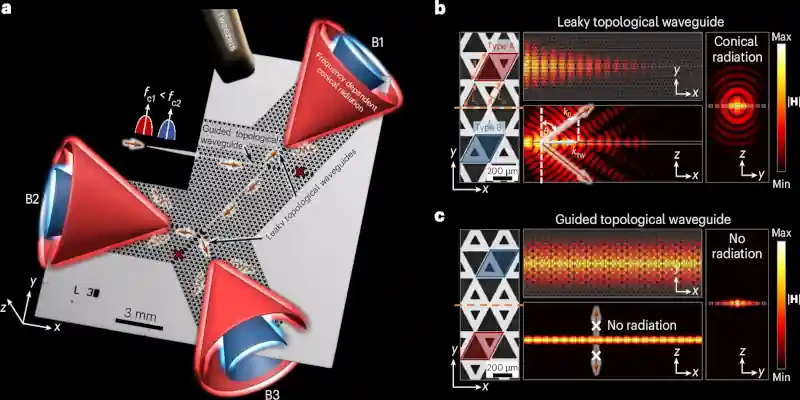
The chip’s geometry determines how and where terahertz waves escape. Smaller and larger holes guide the waves along protected paths until they reach points where the energy is released. This method allows the antenna to transmit information‑carrying signals without requiring active steering. The same structure can also operate as a receiver, capturing incoming terahertz waves and routing them back into the chip.
During testing, the antenna provided both horizontal and vertical coverage, reaching roughly 75% of the surrounding three‑dimensional space. This is more than 30 times the coverage of many existing terahertz antennas. Throughout the experiments, the device maintained data rates hundreds of times higher than those achieved by comparable state‑of‑the‑art systems. These results highlight the potential of topological designs to overcome long‑standing limitations in terahertz communication.
A key advantage of the design is its passive nature. All control is built directly into the chip’s structure, eliminating the need for external motors or electronic steering components. This reduces the risk of mechanical failure and lowers operating costs. The simplicity of the design also makes it easier to integrate into compact communication systems.
Toward Fully Integrated 6G Terahertz Chips
Building on their initial results, Singh’s team plans to explore how transmission, reception and signal processing could be integrated onto a single terahertz chip. Such integration would be essential for practical 6G devices, which must handle high‑frequency signals with minimal loss and maximum efficiency. A unified chip‑based system could reduce size, power consumption and manufacturing complexity. It would also enable new applications that rely on extremely fast wireless links.
The researchers believe that topological photonics offers a promising path toward this goal. By embedding control into the material itself, future devices could achieve high performance without relying on bulky or fragile components. This approach aligns with broader trends in wireless engineering, where passive, geometry‑driven designs are gaining attention. If successful, these efforts could help make 6G networks more reliable and easier to deploy.
The team’s work also contributes to a growing body of research on terahertz technologies. As demand for faster wireless communication increases, interest in terahertz systems has expanded across academia and industry. Many challenges remain, including signal attenuation, device fabrication and system‑level integration. The new antenna design addresses one of these challenges by providing a robust, wide‑coverage solution.
Future studies will likely focus on scaling the design, improving efficiency and integrating additional components. Researchers hope that continued progress will bring terahertz communication closer to everyday use. The development of practical 6G hardware will depend on innovations like this that rethink how high‑frequency signals are generated and controlled.
Topological photonics has gained significant attention over the past decade for its ability to create devices that are resistant to defects and fabrication imperfections. Similar concepts have been explored for optical waveguides, lasers and quantum information systems. Applying these ideas to terahertz antennas represents a new direction that could influence the design of future wireless technologies.