
Turning Regolith Into Space Soil
- Researchers are exploring how recycled sewage could help transform lunar and Martian regolith into soil capable of supporting crops.
- Their work examines how organic waste interacts with simulated extraterrestrial materials to release essential nutrients.
- The findings offer early insights into how future space habitats might sustain agriculture far from Earth.
Recycling Waste to Enable Off‑World Farming
Growing food on the moon or Mars has long been a staple of science fiction, yet scientists are now studying how it could become practical. A new study published in ACS Earth and Space Chemistry describes efforts to convert plant and human waste into fertilizer that can weather barren regolith. Harrison Coker, the study’s first author, explained that organic waste streams could help extract nutrients from lunar and Martian surface minerals. This approach aims to turn inhospitable dust and rock into a medium capable of supporting plant life.
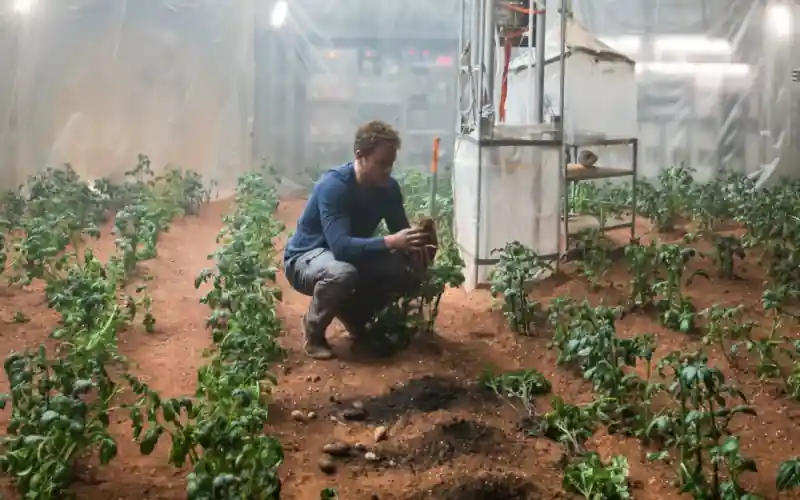
Both celestial bodies are covered in regolith that lacks the organic matter needed for agriculture. Fiction has imagined astronauts using waste to enrich Martian soil, but researchers are now testing similar ideas in controlled experiments. Coker and co‑author Julie Howe are collaborating with NASA to evaluate how recycled sewage interacts with regolith simulants. Their goal is to determine whether the resulting material could sustain crops in future space settlements.
NASA Tests Bioregenerative Life Support Systems
At NASA’s Kennedy Space Center, teams are developing bioregenerative life support systems known as BLiSS. These systems use bioreactors and filters to convert artificial sewage into a nutrient‑rich solution. Researchers combined this effluent with simulated lunar and Martian regolith and placed the mixtures in a shaker for 24 hours. The process allowed them to observe how the waste‑derived solution weathered the mineral particles.
The experiments showed that the treated regolith released significant amounts of essential plant nutrients. Elements such as sulfur, calcium and magnesium became available after exposure to both water and BLiSS solutions. Microscopic analysis revealed physical changes as well, including tiny pits in lunar simulant particles and nanoparticle coatings on Martian simulant grains. These changes reduced abrasiveness and indicated progress toward a more soil‑like material.
Promising Results With More Work Ahead
Although the findings are encouraging, researchers caution that real lunar and Martian regolith differ from laboratory simulants. Additional testing will be needed to understand how actual extraterrestrial materials respond to similar treatments. The team believes that refining these processes will be essential for long‑term human presence beyond Earth. Their work highlights the importance of recycling and resource efficiency in future space habitats.
Transforming regolith into arable soil would reduce reliance on supply missions from Earth. It could also support more sustainable life‑support systems for lunar or Martian bases. The study provides an early framework for how waste management and agriculture might intersect in off‑world environments. Continued research will help determine how close these concepts are to becoming operational.
Bioregenerative life support systems are part of a broader effort to create closed‑loop habitats for deep‑space missions. Similar technologies are being explored for long‑duration stays on the International Space Station and future missions to Mars. Scientists view waste recycling as a cornerstone of sustainable space living, since every resource must be reused whenever possible. The work on regolith weathering adds another piece to the puzzle of how humans might one day farm on other worlds.