

Ultra‑Thin Chip Advances Quantum Computing
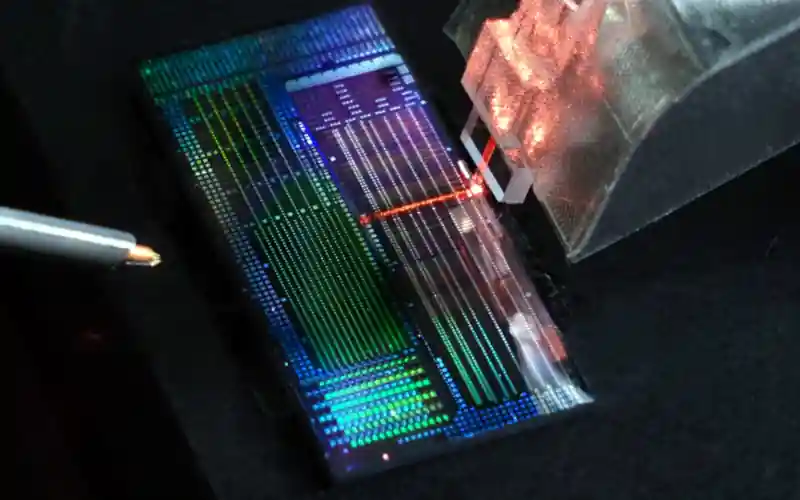
- Researchers have developed an exceptionally thin optical device that could play a key role in scaling future quantum computers.
- The chip precisely controls laser light while being manufactured using standard semiconductor processes.
- Its combination of size, efficiency and mass‑production potential marks a notable step toward practical quantum technologies.
A Scalable Device Built for Quantum Systems
A team of researchers has created an optical phase modulator nearly 100 times thinner than a human hair, offering a new approach to controlling laser light for quantum applications. Their work, published in Nature Communications, demonstrates a device capable of generating highly stable laser frequencies essential for operating large‑scale quantum computers. Instead of relying on custom laboratory setups, the team used fabrication methods similar to those used for everyday microelectronics. This shift makes the technology far more practical for mass production.
The project was led by Jake Freedman, an incoming PhD student, alongside professor Matt Eichenfield and collaborators from Sandia National Laboratories, including co‑senior author Nils Otterstrom. Their goal was to design a device that combines compact size, strong performance and low cost. At the core of the chip are microwave‑frequency vibrations oscillating billions of times per second. These vibrations enable precise manipulation of laser beams, a capability required for quantum sensing, networking and computing.
By directly adjusting the phase of a laser, the device can generate new frequencies with high stability. This level of control is crucial for quantum systems that rely on thousands or millions of qubits. The researchers emphasize that such precision must be achieved at scale to support future quantum architectures. Their design aims to meet that challenge while remaining compatible with existing semiconductor manufacturing.
Why Quantum Computing Requires Precise Laser Control
Many promising quantum computing platforms use trapped ions or neutral atoms as qubits. Each atom must be addressed by laser beams tuned with extreme accuracy, sometimes within billionths of a percent. These beams act as control signals, enabling qubits to store, process and transfer information. Achieving this level of precision across large systems requires reliable and efficient frequency‑shifting technology.
Current laboratory setups rely on bulky electro‑optic modulators that consume significant microwave power. While effective for small experiments, they are not suitable for quantum computers that may require tens of thousands of optical channels. Freedman notes that creating multiple laser copies with exact frequency differences is essential for scaling atom‑based systems. Existing tools cannot meet this demand without substantial size, cost and energy drawbacks.
The new chip addresses these limitations by using about 80 times less microwave power than many commercial modulators. Lower power consumption reduces heat, allowing more devices to be placed on a single chip without thermal interference. This efficiency makes it possible to build dense arrays of optical components needed for large‑scale quantum operations. The result is a more practical path toward systems capable of controlling vast numbers of qubits.
Toward Fully Integrated Quantum Photonic Platforms
One of the project’s most significant achievements is its use of CMOS fabrication, the same process used to manufacture modern microprocessors. Eichenfield describes CMOS as the most scalable technology ever developed, enabling billions of identical components to be produced reliably. Applying this approach to photonics could allow thousands or millions of identical modulators to be manufactured for quantum systems. Such scalability is essential for building practical quantum computers.
Otterstrom explains that the team redesigned traditional modulators—once large, expensive and power‑intensive—into compact, efficient devices suitable for integration. Their work contributes to a broader shift in optics toward an equivalent of the transistor revolution in electronics. Integrated photonic technologies could replace bulky optical components much like transistors replaced vacuum tubes. This transition is expected to accelerate progress in quantum hardware.
The researchers are now developing fully integrated photonic circuits that combine frequency generation, filtering and pulse shaping on a single chip. These efforts aim to create a complete quantum photonic platform capable of supporting advanced trapped‑ion and neutral‑atom systems. Partnerships with quantum computing companies will help test the technology in real‑world environments. Freedman describes the device as one of the final components needed for a scalable photonic architecture.
Optical phase modulators have long been essential tools in telecommunications, where they help encode information onto laser beams for high‑speed data transmission. The same underlying principles are now being adapted for quantum technologies, highlighting a convergence between classical and quantum photonics. As integrated photonics matures, researchers expect cross‑industry innovations to accelerate both fields. This overlap may lead to new hybrid devices that serve communication networks and quantum processors simultaneously.
picture: Optical chip developed in the study with laser light from an optical fiber array. Credit: Jake Freedman